
Introduction
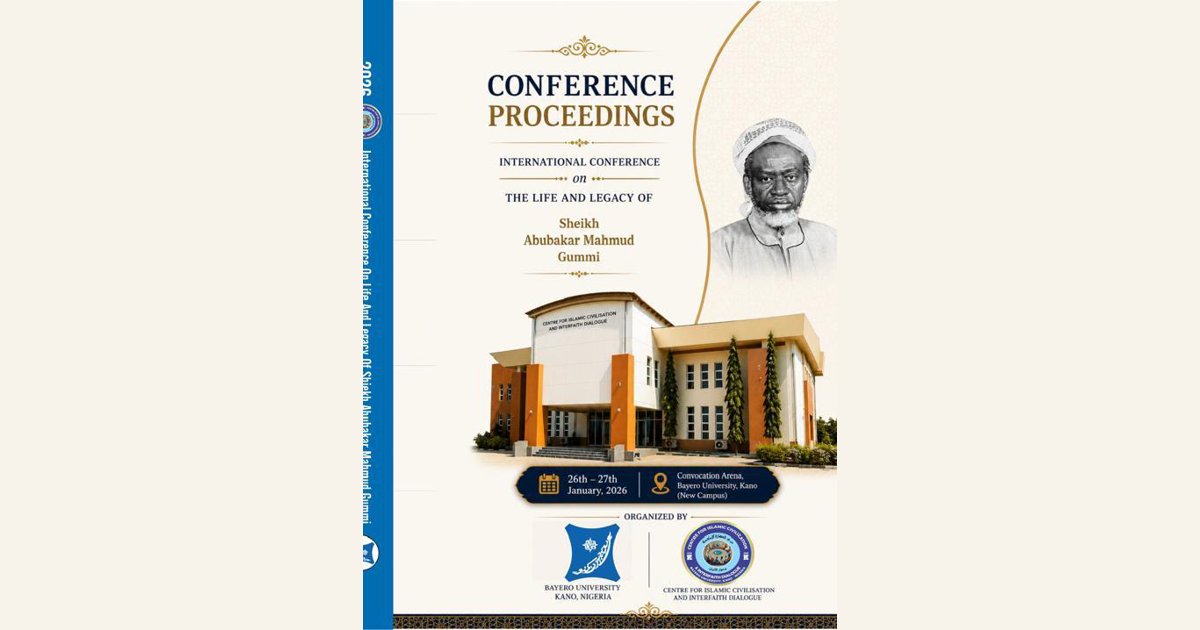
It is with great pleasure that I present to the esteemed reader the Proceedings of the Fourth International Conference organised by the Centre for Islamic Civilisation and Interfaith Dialogue, Bayero University, Kano, Nigeria, under the theme:
“The Life of Shaykh Abubakar Mahmud Gumi and His Intellectual Legacy: Renewing Scholarly Activity and Socio-Political Discourse in Contemporary Nigeria.”
This conference constitutes the fourth international academic conference convened by the Centre since its establishment. It forms part of the Centre’s broader intellectual and scholarly mandate to illuminate the diverse dimensions of Islamic civilisation, critically examine its formative elements and enduring foundations, and recover those aspects of its intellectual heritage that remain relevant to the challenges of contemporary society.
At the heart of this mandate is the conviction that a meaningful engagement with Islamic civilisation can contribute significantly to the cultivation of a just, harmonious, and cohesive society one founded upon the principles of cooperation, tolerance, mutual understanding, and respect among peoples, religions, and cultures. The Centre therefore seeks not merely to revisit the past as an object of historical inquiry, but to engage critically with its intellectual and civilizational heritage in ways that illuminate the present and inform the future.
The Centre’s scholarly programmes and conferences are consequently designed to revisit significant chapters of Islamic intellectual and civilisational history, examine their achievements and experiences, and draw from them lessons of enduring relevance. Such an undertaking is particularly important at a time when Muslim societies are confronted by complex intellectual, social, political, cultural, and developmental challenges. A critical engagement with the rich heritage of Islamic civilisation can serve not as an invitation to exaggerate the past, but as a means of recovering the intellectual confidence, ethical vision, spirit of inquiry, and culture of learning that historically animated Muslim societies.
History bears witness to the remarkable contribution of Islamic civilisation to the advancement of human knowledge. At a time when large parts of Europe were passing through prolonged periods of intellectual and cultural stagnation, the Muslim world witnessed an extraordinary flourishing of scholarship, scientific inquiry, intellectual production, and cultural creativity. Muslim scholars made influential contributions to disciplines as diverse as mathematics, astronomy, geography, medicine, engineering, philosophy, and numerous other branches of knowledge. Their works not only enriched the intellectual heritage of the Muslim world but also contributed, directly and indirectly, to the development of global civilisation.
It is against this broader civilisational backdrop that the Centre continues to explore the lives, ideas, contributions, and legacies of scholars and reformers whose intellectual endeavours shaped their societies and whose thought continues to offer valuable insights for the present. The study of such figures provides an opportunity to examine how scholarship can respond to social realities, how religious thought can engage constructively with contemporary challenges, and how intellectual leadership can contribute to social transformation.
It was within this intellectual framework that the Centre conceived the theme of this Fourth International Conference:
The choice of Shaykh Abubakar Mahmud Gumi as the focus of this conference is both timely and significant. He occupies a distinctive place in the modern intellectual, religious, and sociopolitical history of Nigeria. As a scholar, reformer, preacher, and public intellectual, he played a notable role in shaping religious discourse, promoting Islamic scholarship, and engaging with the social and political questions of his time.
The conference therefore seeks to move beyond a merely biographical appreciation of Shaykh Gumi and to undertake a critical and multidimensional examination of his intellectual legacy. It provides a scholarly forum for investigating his contributions to Islamic learning, religious reform, education, preaching, social thought, and public discourse, while also examining the wider historical context within which his ideas and activities developed.
More importantly, the conference invites reflection on the continuing relevance of his intellectual and reformist legacy to contemporary Nigeria. In an era characterized by rapid social transformation, changing patterns of religious engagement, political contestation, technological advancement, and increasingly complex societal challenges, there is a pressing need to revisit the intellectual resources of the past and assess their potential contribution to addressing the realities of the present.
The papers assembled in this volume are therefore intended not only to document the scholarly contributions presented at the conference, but also to stimulate further academic inquiry into the intellectual history of Nigeria and the broader Muslim world. They represent diverse perspectives and approaches to understanding Shaykh Abubakar Mahmud Gumi, his intellectual milieu, his contributions, and the enduring questions raised by his legacy.
It is our hope that these proceedings will serve as a valuable academic resource for scholars, researchers, students, policymakers, religious leaders, and all those interested in the intellectual and socio-political history of contemporary Nigeria. We further hope that they will encourage continued research into the relationship between Islamic scholarship, intellectual renewal, social reform, and responsible public engagement.
Ultimately, the significance of this conference lies not simply in remembering a distinguished scholar of the past, but in engaging critically with his intellectual legacy in order to illuminate the possibilities of the present and contribute constructively to the future. Through such scholarly engagement, we may recover lessons from our intellectual heritage, renew the culture of learning and critical inquiry, and strengthen the capacity of scholarship to respond meaningfully to the challenges facing Nigerian society and the wider Muslim community.
May Allah accept this scholarly endeavour, make it beneficial to its readers, and guide us towards knowledge that enlightens the mind, refines character, strengthens society, and contributes to the advancement of humanity.
Prof. Taufiq Abubakar Hussaini, Chairman, Conference Executive Committee
24th Safar, 1448AH 8th July, 2026 CE
Comments