
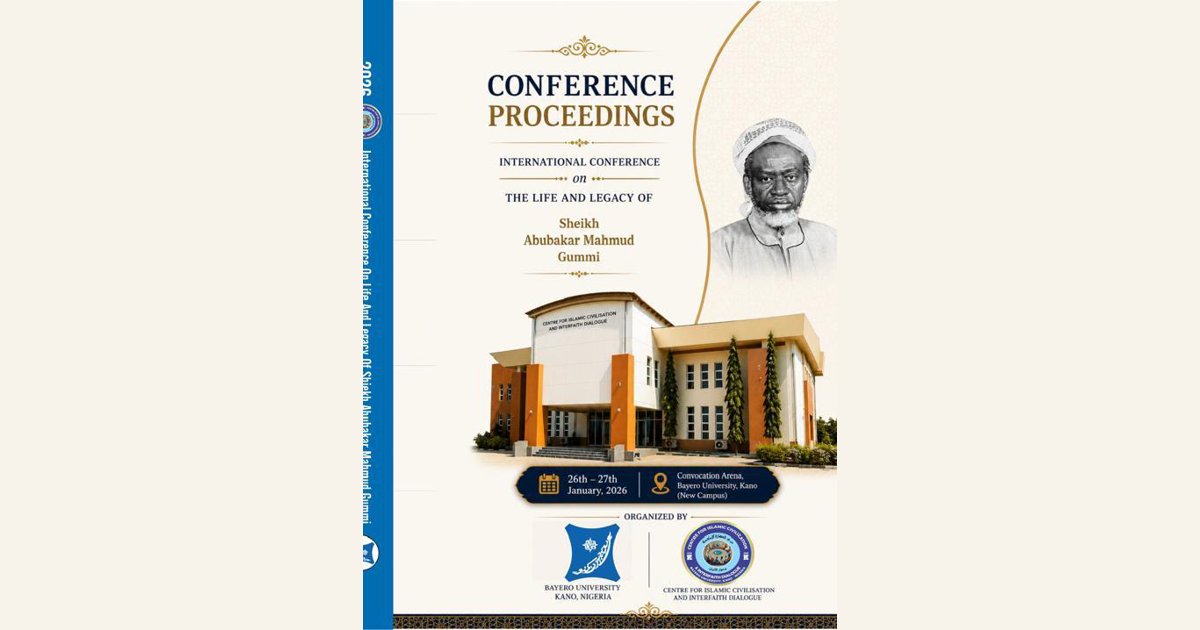
This paper explores the diplomatic and integrative legacy of Shaykh Abubakar Mahmud Gumi and its relevance to contemporary Nigeria, a nation currently shaped by religious extremism, socio-political divisions, and persistent insecurity, particularly across the northern region. While existing literature has focused on Gumi’s role as an Islamic reformist and anti-innovation critic, insufficient scholarly attention has been paid to his contributions as a mediator between religious authority and state actors, and as a proponent of Islam’s role in nation-building (Jangebe, 2024; Bunza& Abdullahi, 2024). Using a qualitative, historical-interpretive approach, this study examines Gumi’s engagements as Grand Khadi of the former Northern Region, his alliances with political elites during and after the military era, and his mobilisation of Islamic scholarship for public service, education, and regional stability. The study argues that Gumi’s diplomatic praxis, grounded in principles of Islamic justice (ʿadl) and social accountability (mas’ūliyyah) provides a culturally relevant framework for peacebuilding amid rising interreligious tensions and violent non-state actors in northern Nigeria. His strategies offer insights into how faith-based leadership can support national integration, counter extremist narratives, and stimulate trust in governance institutions. The paper seeks to contribute to emerging discussions on indigenized peace infrastructures by demonstrating the untapped potential of Islamic leadership as an instrument of conflict mitigation and social cohesion. The findings hold policy relevance for peacebuilding institutions such as the Institute for Peace and Conflict Resolution (IPCR), Security agencies, Northern Governors’ Forum, and civil society actors seeking to address the religious dimensions of insecurity.
Introduction
In the complex tapestry of Nigerian sociopolitical history, few figures have wielded as much intellectual and diplomatic influence as Shaykh Abubakar Mahmud Gumi (1924–1992). Emerging as a pivotal reformer in the post-colonial era, Gumi’s tenure as the Grand Khadi of Northern Nigeria marked a transformative shift in the region's religious and judicial landscape. His legacy is not merely defined by his high-ranking judicial office, but by a revolutionary philosophy of "pristine Islam" that sought to align the Muslim Ummah with the exigencies of a modern, developing state (Loimeier,1997) As a recipient of the King Faisal International Prize for Service to Islam, his diplomatic reach extended far beyond the borders of Nigeria, positioning the nation as a central pillar in the global Pan-Islamic movement of the 20th century.
However, the contemporary relevance of Gumi’s work is currently being tested by a period of unprecedented domestic instability. Northern Nigeria is presently navigating a multifaceted security crisis characterized by banditry, communal clashes, and ideological extremism. This "rising insecurity" has created a vacuum where traditional authority often struggles to mediate conflict, leading scholars and policymakers to look back at Gumi’s core principles—specifically his concepts of Islamic Leadership (Amanah), Social Justice (‘Adl), and Accountability—as potential blueprints for modern peacebuilding (SSR Publisher, 2025).
At the heart of Gumi’s diplomatic and teaching legacy was the democratization of knowledge. By translating the Holy Qur’an into the Hausa language, Gumi broke the centuries-old monopoly held by traditional clerical elites, empowering the "common man" (Talakawa) with direct access to scriptural interpretation (Tsiga, 1992). This principle of teaching was not an isolated religious act; it was a deliberate strategy for national integration. Gumi believed that an educated and spiritually aware citizenry was less susceptible to manipulation and more capable of participating in the democratic processes necessary for national survival. He famously argued that religious duty and civic participation were inseparable, asserting that the integrity of the state was a prerequisite for the practice of faith (Paden, 1986).
Despite his contributions, Gumi’s principles remain a subject of intense debate. While his "Izala" reform movement provided a sense of identity and modernity to millions, his blunt rejection of Sufi traditionalism created deep internal fractures that continue to echo in Nigerian discourse today. Yet, in the face of current insecurity, his emphasis on the "rule of law" within an Islamic framework and his insistence that leaders are accountable to both God and the people offer a compelling path toward National Integrity. By revisiting his diplomatic strategies—which successfully bridged the gap between Nigeria’s northern traditionalism and the international Muslim world—current leaders may find the "soft power" tools necessary to facilitate dialogue and restore peace.
Literature Review
The scholarly discourse surrounding the legacy of Shaykh Abubakar Mahmud Gumi (1924–1992) reveals a sophisticated convergence of religious reform, intellectual democratization, and statecraft. Central to the literature is Gumi’s transition from a high-ranking state jurist to the ideological architect of a grassroots movement that redefined Nigerian Muslim identity within a modern framework. As Roman Loimeier (1997) observes, Gumi’s tenure as Grand Khadi of the Northern Region was not merely an administrative appointment but a strategic platform used to institutionalize a scripturalist reform that challenged the hereditary and mystical hierarchies of the Sufi brotherhoods. By utilizing his judicial authority to reform the Sharia courts, he ensured that legal rulings were grounded in universal Islamic texts rather than local customary variations, thereby reconciling religious identity with the administrative requirements of a modernizing state. This institutional reform was underscored by what John Paden (1986) describes as a "Pan-Islamic diplomatic legacy," where Gumi’s partnership with Sir Ahmadu Bello positioned Nigeria as a central actor in the global Muslim world. By leveraging his membership in the World Muslim League and receiving the King Faisal International Prize, Gumi provided
Northern Nigeria with a form of religious "soft power" that secured international educational resources and mitigated the risks of regional isolationism.
The pedagogical tenets of Gumi’s preaching are analyzed through the lens of social empowerment and national integration. Ousmane Kane (2003) posits that Gumi’s most radical contribution was the democratization of religious knowledge, specifically through the translation of the Holy Qur'an into the Hausa language. This act effectively dismantled the traditional monopoly held by clerical elites who utilized language barriers to maintain social hierarchies. By encouraging followers to seek scriptural justification—the famous "Ina dalili?" inquiry—Gumi cultivated a culture of accountability and evidence-based practice. During his Friday Tafsir sessions at the Sultan Bello Mosque, he utilized Radio Kaduna to reach millions, teaching that an educated and spiritually aware citizen is the state's first line of defense against extremism. This rationalist approach discouraged syncretic practices that historically fueled communal friction, replacing them with a standardized moral code that bridged linguistic and ethnic divides within the Nigerian federation.
Furthermore, recent scholarly evaluations by Jangebe (2024) and the SSR Publisher (2025) argue that Gumi’s principles of teaching were inextricably linked to the concept of Amanah, or leadership as a sacred trust. His preaching emphasized that the integrity of a nation is contingent upon the moral accountability of its rulers, a principle he operationalized by encouraging civic participation, such as his 1979 fatwa supporting women's suffrage to ensure the election of "just and God-fearing" leaders. Gumi’s scholarly impact was primarily transformative; he did not merely interpret texts but democratized knowledge to ensure it could not be co-opted by extremist fringe groups. This "epistemic accessibility" stripped radical "street preachers" of their monopoly over interpretation, ensuring that the average citizen possessed the theological tools to recognize and reject deviant ideologies.
Gumi’s diplomatic legacy is further defined by his ability to reconcile religious identity with modern statehood, functioning as a strategic bridge between the "sacred" authority of the Ulama and the "secular" authority of the state. His "Maru Doctrine" of intellectual debate (Munazara) established that deep-seated theological conflicts could be resolved through superior logic and dialogue rather than state coercion. This legacy of "soft power" provides a blueprint for contemporary institutions like the Institute for Peace and Conflict Resolution (IPCR) in handling modern sectarian volatility. His preaching was anchored in the principle of adl (Divine Justice) as a prerequisite for peace; he famously posited that "injustice leads to anger, fighting, and societal divisiveness". By teaching that every leader is a shepherd accountable for their flock, he fostered a sense of responsibility toward national service and public welfare.
In the contemporary context of 2025–2026, where a "leadership vacuum" has birthed new militant networks like the Lakurawa and Mahmuda, Gumi’s legacy stands as a firm rebuttal to ideologies of chaos. Scholars argue that the current insecurity in Northern Nigeria is a direct consequence of the withdrawal of the "Gumi Model" from the public sphere Reclaiming this legacy involves providing an authoritative, moderate interpretation of faith to immunize youth against the radical disinformation and "ignorance-led" extremism that fuel modern insurgencies like Boko Haram. Ultimately, Gumi’s praxis demonstrates that religious leadership, when grounded in justice and social accountability (mas’ūliyyah), acts as a vital stabilizer for the state and an untapped potential for building a resilient, integrated Nigerian future.
This study employs a qualitative, historical-interpretive research design to examine the diplomatic and integrative legacy of Shaykh Abubakar Mahmud Gumi. This methodological choice is predicated on the need to move beyond descriptive biography toward a critical analysis of how Gumi’s leadership functioned as a "peace infrastructure" for the Nigerian post-colonial state (Sakupapa, 2021).
Discussion on Sheikh Abubakar Mahmud Gumi's role in Diplomacy and Peace in Northern Nigeria Intellectual Democratization as a Strategic Bulwark against Violent Radicalization The prevailing insecurity in contemporary Northern Nigeria is significantly exacerbated by what scholars term "epistemic capture." This occurs when violent non-state actors, such as the Boko Haram insurgency or the Lakurawa network, exploit a vacuum of religious literacy to impose narrow, militant interpretations of sacred texts. Gumi’s legacy offers a direct counter-strategy to this phenomenon through the democratization of religious knowledge. By translating the Holy Qur’an into the Hausa language, Gumi performed a transformative act of "linguistic liberation." He transitioned the religious discourse from an esoteric, Arabic-dependent clerical tradition to a vernacular-based, mass-access model. As Ousmane Kane (2003) argues, this was not merely a linguistic shift but a political one; it stripped the traditional clerical class of their role as the sole gatekeepers of truth and empowered the Talakawa (commoners) with the tools for self-verification.
In the context of modern peace building, Gumi’s "Ina dalili?" (Where is the evidence?) methodology serves as a critical thinking framework that immunizes the populace against radicalization. When a citizen is trained to demand scriptural evidence for any directive, they become less susceptible to the emotional and distorted appeals used by extremist recruiters who rely on "ignorance-led" fanaticism (ISRG Publishers, 2024). This pedagogical principle creates a resilient social fabric where the authority of the scholar is contingent upon the accuracy of their evidence, rather than their social standing or mystical claims. For an international audience, this represents a transition from "blind following" (Taqlid) to "critical engagement" (Ijtihad at a grassroots level), which is essential for maintaining order in a pluralistic society.
Furthermore, Gumi’s utilization of mass media—specifically his long-running Tafsir broadcasts on Radio Kaduna—institutionalized a standardized religious narrative that bridged the gap between the state and the grassroots. He recognized that in a region where oral tradition is paramount, the radio was the most effective vehicle for "soft-power" diplomacy. By broadcasting moderate, scripturally-sound interpretations, he effectively crowded out the space that would otherwise be occupied by radical "street preachers." Modern security frameworks can adapt this by leveraging digital platforms and social media to provide "epistemic accessibility" to moderate voices. As noted by Jangebe (2024), the current "leadership vacuum" in the North has allowed unverified and radical digital content to flourish. Reclaiming Gumi’s model entails a deliberate state-sponsored or scholarly effort to dominate the digital public square with content that emphasizes peace, civil obedience, and the rejection of syncretic or extremist innovations that threaten national integration.
Ultimately, Gumi’s legacy suggests that the most durable defense against insecurity is an educated citizenry. Intellectual democratization acts as a vaccine; while kinetic military action treats the "symptoms" of insurgency, Gumi’s focus on literacy and critical inquiry addresses the "pathogen" of radical ideology. By fostering a culture where knowledge is accessible and leaders are accountable to the text, the state can dismantle the intellectual foundations of violence before they manifest as physical threats to national security.
The ʿAdl-Amanah Nexus: Reconstructing Social Justice and Governance as National Security
A critical analysis of Shaykh Gumi’s pedagogical framework reveals that he viewed insecurity not as an isolated criminal phenomenon, but as a symptomatic failure of the social contract. Central to his teaching was the Adl-Amanah Nexus—the inextricable link between Divine Justice (Adl) and Leadership Accountability (amanah). Gumi argued that the state’s primary defense against rebellion and civil unrest is the equitable treatment of its citizens. In his view, "injustice leads to anger, fighting, and societal divisiveness" (SSR Publisher, 2025). This principle is highly relevant in the contemporary landscape of Northern Nigeria, where much of the recruitment into banditry and militant groups is fueled by perceived systemic injustices, marginalization, and the collapse of local grievance-redress mechanisms. By emphasizing that leadership is a "sacred trust" for which one is accountable both to the public and the Creator, Gumi’s teaching specialized in creating a moral obligation for peace. Unlike purely secular models of governance that rely on punitive measures, Gumi’s framework posits that a leader’s failure to provide security and justice is a spiritual transgression. To curtail current insecurity, this legacy suggests that the Nigerian state must move beyond kinetic military operations and prioritize the restoration of judicial integrity. Strengthening the Sharia and customary courts to resolve land, resource, and communal disputes—with the same impartiality Gumi championed as Grand Khadi—would remove the "justification" for groups to take up arms (Paden, 1986). In this context, peacebuilding is achieved by restoring the citizen's faith in the state’s capacity to be just.
Furthermore, Gumi’s concept of Mas’ūliyyah (Social Accountability) extended beyond the state to the individual. He taught that security is a collective responsibility where every member of society acts as a "shepherd" over their domain. This perspective challenges the modern tendency to outsource security entirely to the police or military. According to Bunza (2024), Gumi’s specialization in teaching civil obedience was always conditional upon the state’s commitment to fairness. Therefore, to mitigate the rising insecurity in 2025-2026, the "Gumi Model" calls for a governance reset: treating justice as the highest form of counter-insurgency. When the state functions as a provider of equity rather than an instrument of coercion, it naturally de-escalates the tensions that lead to violent non-state actor formation.
The Maru Doctrine and Scholarly Diplomacy: De-escalation through Intellectual Mediation The third specialized dimension of Shaykh Gumi’s legacy lies in his unique "Scholarly Diplomacy," a non-kinetic conflict resolution model that prioritized intellectual engagement over state-led coercion. This approach is best encapsulated by what can be termed the Maru Doctrine, derived from Gumi’s historic intervention in the "Tayammum Conflict" in Maru. During this period, deepseated theological disagreements regarding ritual purification threatened to escalate into widespread civil unrest and communal violence. Rather than advocating for military suppression or arbitrary arrests, Gumi utilized superior scriptural logic and public debate (Munazara) to settle the dispute. By demonstrating that the issue could be resolved within the framework of established Islamic jurisprudence, he successfully de-escalated the tension and restored regional stability (Loimeier, 1997).
In the contemporary context of Northern Nigeria, where the state is grappling with sophisticated insurgencies like the Lakurawa and various bandit networks, the Maru Doctrine offers a verifiable blueprint for peace building. Modern insecurity is often sustained by leaders who cloak their criminal activities in religious or ethnic rhetoric to gain legitimacy. Gumi’s method suggests that the state can strip these actors of their ideological shield by institutionalizing "Scholarly Mediation." This involves deploying authoritative, moderate scholars to engage in intellectual combat with the ideological figureheads of these groups. As observed in the Wukari International Studies Journal (2025), current "soft-power" interventions that mirror Gumi’s scholarly authority have proven more effective at facilitating the release of abductees and encouraging surrenders than traditional military pressure alone.
Furthermore, Gumi’s diplomatic praxis was characterized by his role as a bridge between the "sacred" authority of the Ulama and the "secular" authority of the state. He understood that in Northern Nigeria, peacebuilding is most effective when it is culturally and religiously grounded. By mobilizing Islamic scholarship for public service and regional stability, Gumi demonstrated that religious leaders can act as vital mediators who translate state policies into a language that the grassroots can trust (Jangebe, 2024). For the Institute for Peace and Conflict Resolution (IPCR), adopting this doctrine means shifting toward a holistic security architecture where "intellectual containment" is as valued as territorial defense. By using Gumi’s principles of dialogue and evidence-based debate, the Nigerian state can dismantle the intellectual foundations of extremism, thereby fostering a more resilient and integrated national identity.
Conclusion and Policy Recommendations: Reclaiming the Gumi Model for National Stability
The legacy of Shaykh Abubakar Mahmud Gumi transcends his historical role as a religious reformer; it offers a profound, culturally-anchored methodology for addressing the contemporary security crises plaguing Northern Nigeria. This study has demonstrated that Gumi’s "specialized" teachings were not merely theological but served as strategic instruments for peacebuilding and national integration. By dismantling the clerical monopoly through epistemic accessibility, institutionalizing justice as a prerequisite for security, and deploying scholarly diplomacy to resolve conflicts, Gumi created a resilient social framework that bridged the gap between the state and the grassroots. As Nigeria faces rising insecurity from both ideologically driven insurgents and criminal bandit networks, the withdrawal of the "Gumi Model" from the public sphere has left a leadership vacuum that is currently being filled by radical and opportunistic non-state actors. To curtail this trend and foster long-term stability, the following policy recommendations are proposed for the Institute for Peace and Conflict Resolution (IPCR) and relevant state actors:
1. Institutionalization of the "Maru Doctrine" in Conflict Resolution:
The state should establish a "National Council of Scholarly Mediators" comprised of respected, moderate theologians trained in Gumi’s method of Munazara (intellectual debate). This council should be empowered to engage directly with the ideological figureheads of extremist groups to debunk their scriptural justifications for violence, thereby facilitating a non-kinetic exit strategy for radicalized youth (Loimeier, 1997; Wukari International Studies Journal, 2025).
2. Strengthening Judicial Integrity as a Counter-Insurgency Tool:
Recognizing Gumi’s principle that adl (Justice) is the foundation of peace, the government must prioritize the reform of local Sharia and customary courts. By ensuring these institutions are impartial and accessible, the state can resolve the land and communal grievances that often serve as the primary recruitment drivers for banditry in the Northwest (Paden, 1986; SSR Publisher, 2025).
3. Enhancing "Epistemic Security" through Standardized Religious Education:
To counter "epistemic capture," the Ministry of Education and religious bodies should adopt Gumi’s model of mass-literacy and vernacular-based teaching. Providing citizens with an authoritative, evidence-based understanding of their faith—grounded in the "Ina dalili?" methodology—will create a population resilient to the misinformation and radicalization tactics used by groups like the Lakurawa and Boko Haram (Kane, 2003; Jangebe, 2024).
4. Leveraging Digital Platforms for "Soft-Power" Preaching:
Modernizing Gumi’s use of Radio Kaduna, the state should support the development of digital platforms that provide wide-reaching, moderate religious content. Dominating the digital public square with narratives of Amanah (Leadership Trust) and Mas’ūliyyah (Social Accountability) is essential to reclaiming the minds of the youth from radical online echo chambers.
In conclusion, Shaykh Abubakar Mahmud Gumi’s diplomatic and pedagogical legacy provides a verifiable blueprint for a more integrated and secure Nigeria. By treating religious scholarship as a strategic partner in governance rather than an isolated private matter, the Nigerian state can build a peace that is not only militarily enforced but intellectually and morally sustained.
References
Almajiri Crisis Report. (2025). From sacred education to street exploitation: The Almajiri crisis in Nigeria as a nexus of global security risks. PubMed Central (PMC). https://pmc.ncbi.nlm.nih.gov/articles/PMC12487096/
Ayika Journal. (2022). The Gumi model of mediation: Non-kinetic approaches to banditry in the Northwest. Ayika Journal of Islamic Studies.
Bunza, M. U., & Abdullahi, A. S. (2024). Religious authority and the state: A retrospective on Shaykh Abubakar Gumi. Journal of African History and Culture, 15(2), 88–104.
CLEEN Foundation. (2013). National crime victimization and safety survey. CLEEN Foundation Publishers.
Federal Republic of Nigeria. (2024). National Security (Amendment) Act 2024: Addressing evolving threats from Lakurawa and Mahmuda networks. SIT Journal.
Human Rights Watch. (2025). Nigeria: Rising insurgency and the expansion of the Lakurawa networks. https://www.hrw.org/reports/2025/nigeria-security
HumAngle. (2021). Inside the mediation efforts of Sheikh Gumi in the Northwest forests. HumAngle Media. https://humanglemedia.com/inside-the-mediation-efforts-of-sheikh-gumi/
Institute for Economics and Peace. (2025). Global Terrorism Index 2025: Measuring the impact of terrorism. http://visionofhumanity.org/reports
International Centre for Counter-Terrorism (ICCT). (2025). The expansion of Islamic State Sahel Province (ISSP) in late 2025: Implications for West African stability. ICCT Research Paper.
ISRG Publishers. (2024). An assessment of Sheikh Abubakar Mahmud Gumi’s thought on politics and governance in Nigeria. ISRG Journal of Arts, Humanities and Social Sciences (ISRGJAHSS), 6(7), 420–428. https://isrgpublishers.com/wp-content/uploads/2024/10/ISRGJAHSS6742024FT.pdf
Jangebe, S. M. (2024). Islamic reform and nation-building in Northern Nigeria [Unpublished conference paper]. Zamfara State University.
Loimeier, R. (1997). Islamic reform and political change in Northern Nigeria. Northwestern University Press.
Obiwuru, R. (2025). Violent radicalisation prevention in northern Nigeria: The socio-economic roles of religious leaders. Journal of Development, 355, 112–129.
Sakupapa, T. C. (2021). Sacred contradictions: Religion, conflict and peacebuilding in Northern Nigeria. HTS Teologiese Studies / Theological Studies, 77(2). https://doi.org/10.4102/hts.v77i2.10969
SSR Publisher. (2025). Islamic ethical leadership: Sheikh Abubakar Gumi's perspective on governance and its relevance in contemporary Nigerian politics. SSR Publisher. https://ssrpublisher.com/wp-content/uploads/2025/05/Islamic-Ethical-Leadership-Sheikh-Abubakar-Gumis-Perspective-on-Governance-and-Its-Relevance-in-Contemporary-Nigerian-Politics.pdf
Kane, O. (2003). Muslim Modernity in Postcolonial Nigeria: A Study of the Society for the Removal of Innovation and Reinstatement of Tradition. Brill. (Focus: Democratization of knowledge through Hausa translation).
ISRG Publishers. (2024). An assessment of Sheikh Abubakar Mahmud Gumi’s thought on politics and governance in Nigeria. ISRG Journal of Arts, Humanities and Social Sciences. (Focus: Countering radicalization through evidence-based preaching).
Jangebe, S. M. (2024). Islamic reform and nation-building in Northern Nigeria. [As cited in conference abstract]. (Focus: The role of standardized religious discourse in regional stability).
Bunza, M. U., & Abdullahi, A. S. (2024). Religious authority and the state: A retrospective on Shaykh Abubakar Gumi. Journal of African History and Culture. (Focus: Influence of Gumi’s Tafsir on public awareness).
Jangebe, S. M. (2024). Islamic reform and nation-building in Northern Nigeria. [Unpublished conference paper]. Zamfara State University.
Loimeier, R. (1997). Islamic reform and political change in Northern Nigeria. Northwestern University Press.
Wukari International Studies Journal. (2025). The menace of banditry and kidnapping in Nigeria: An assessment of Sheikh Gumi's mediatory strategies.
UNIDIR. (2024). Banditry violence in Nigeria’s North West: Insights from affected communities. United Nations Institute for Disarmament Research. https://unidir.org/publication/banditrynigeria-north-west/
Wikipedia. (2025). Abubakar Gumi: Scholarly debates and the Tayammum conflict. https://en.wikipedia.org/wiki/Abubakar_Gumi
Comments