I. Preamble:
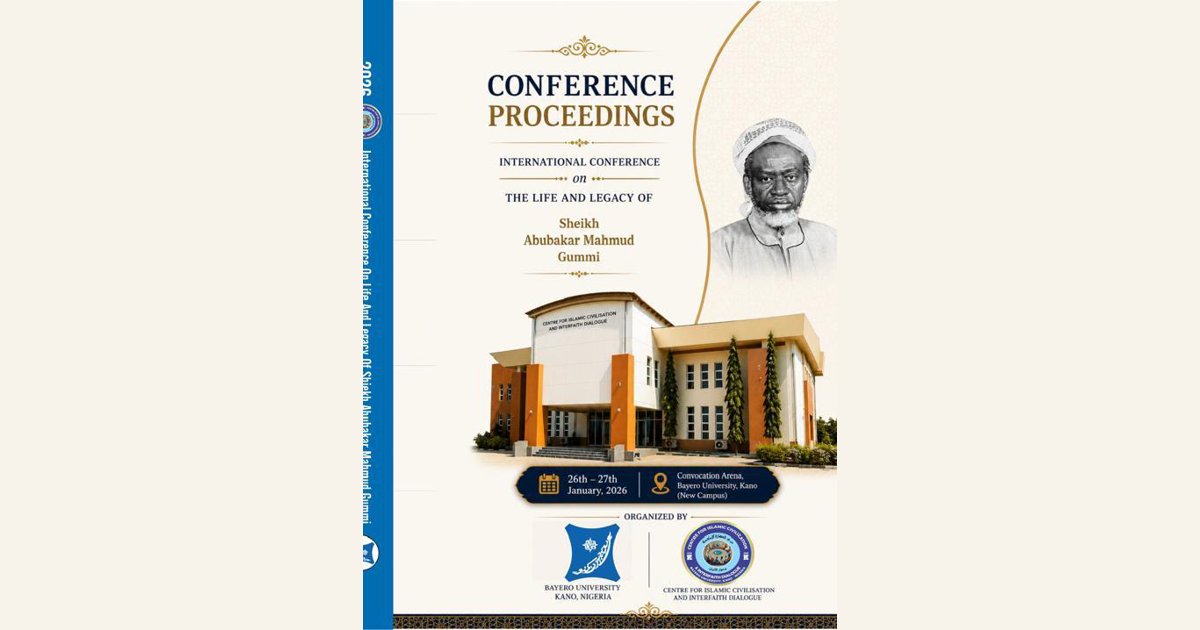
I begin by extending my sincere appreciation to the Bayero University, Kano, and in particular, Center for Islamic Civilization and Interfaith Dialogue under the able leadership of Prof. Tawfeeq Abubakar Hussain for organizing this conference today in the history of our great nation, Nigeria. I’m also particularly honored and humbled to be invited to participate and present a paper at this august gathering; and you requested that I should discuss on “Sheikh Abubakar Gumi, Islamic Reform and Political Transformation’, the directive which, I humbly accept to handle.
This apt and timely International Conference on the Life and Legacy of Sheikh Abubakar Mahmud Gummi has indeed come at a very important period in our history when his life style, and personal etiquettes are critically needed to be revisited and popularized in order to rejuvenate the decaying values among scholars, students, leaders, policy, and decision makers in Nigeria.
I think what everyone could visibly remember about Abubakar Gummi was fundamentally his ascetic personal life, that he had not valued materialism and accumulation of wealth or political power to himself or his relations in all ramifications throughout his endeavors and services to humanity. In the same vein, his Da’awa approach, his straightforwardness, modesty, unpretentiousness and ingeniousness and calmness while saying the truth are models for todays Du’aat and scholars. His modern and Islamic education expertise was rare at the period not only in Nigeria, but the West African sub-region. He was a Geography and Mathematics teacher at Maru Teachers College in the 1940s, at the same an Islamic scholar and an Imam. That singular rare opportunity made him a bridge between between traditional and modern world; which he exploited optimally to advance the interest of Islam in the 20th century Nigeria.
II. About Sheikh Abubakar Gummi
Abubakar was the son of Alkali Mahmud na-Gumi, born on 7th November, 1924 in Gumi town, Mahmud settled at the town of Gummi after decades of wandering and teaching Islamic religion, he was easily the most learned man around, and many scholars came to learn from him’. His grand father was Malam Muhammad Marina, the son of Sheikh Aliyu Barou el-Badawi, an Arab from Bedouin nomads, Muhammad Marina was one of the three children of el-Badawi. They were all men and, like their father, they devoted themselves to Islamic scholarship. (Gumi & Tsiga, 1993)
Young Abubakar started learning Islamic education at a tender age from his parents, Alkali Mahmud and Malama Aminatu, his father and mother respectively; who were both learned scholars. The pursuit for knowledge chosen by Gummi entered a new horizon, when in addition to Islamic education, his father enrolled him into Elementary School at Dogondaji, in present day Sokoto State , and later to Sokoto Central Elementary School, and further to Middle School at Sokoto from 1936 to 1942. Gummi strictly kept his study in both Islamic and Western education well balanced and simultaneously pursued up to the point of attaining level of recognition as a scholar in both fields. That what made him further distinct among scholars of his time in the region.
A British Journalist, Karl Maier, sums up brief about Gumi in the following:
He mastered Arabic and was an interpreter and adviser to Sir Ahmadu Bello, then the Premier of Northern Nigeria, and the Sardauna of Sokoto, site of the Islamic Caliphate. Gumi served as an External Affairs Office in Lagos before becoming Deputy Grand Khadi of Northern Nigeria, a position of spiritual leadership, in 1960. Two years later, he was elevated to Grand Khadi. He was a member of the Judicial Advisory Council to the Supreme Military Council, the military government that ruled from 1966 to 1975. He received Nigeria's highest award, the Commander of the Order of the Federal Republic, COFR.
(He also received the highest Egyptian Honor though Egyptian President Jamal AbdulNasir). It was (mainly) for his translation of the Koran into Hausa, the language of millions of northern Nigerians and others throughout West Africa, that Gumi was awarded in Saudi Arabia the King Faisal International Award, reputedly Islam's highest service honor. He died in London on 11th September 1992.
III. Gummi: A Reformer (Islamic Concept of Reformer-Mujaddid) The nature of Islam as a revivalist religion with its dynamic approach to spiritual and temporal aspects of life provided Gummi the gateway into the established Islamic tradition of reform from his middle cadre carrier as a scholar. According to Prof. John Hunwick:
Islam has been a faith with an activist tradition, both in theory and in practice. The Qur'an, encouraged Muslims to stand up for their faith against enemies and make Islam triumphant: "Say to those who disbelieve, that if they desist, God will pardon them for what has passed, but if they repeat it then the example of earlier folk has gone before. Fight them until there be no more dissent in the land and religion is all for God" [8: 28-9] Muslims were exhorted by the Qur'an to "strive in God's way", to undertake jihad for the defence of Islam and for its ultimate triumph. (Hunwick, 1992.)
Hunwick further adds that: ‘There is a close connection in the Islamic tradition between reform and revival. Over the early centuries of Islam Muslims began to develop a horror of what they called "innovation" (bid'a): A hadith says: "Every innovation is an errancy, and errancy leads to Hell". But by the beginning of the fifth century of Islam questions of orthodoxy (correct belief) and orthopraxy(correct practice) had been largely settled, and thereafter for the next eight centuries or so, what remained to be done was largely a matter of fine tuning. The great challenge was how to preserve what was already there, how to protect the beliefs of Muslims from the influence of ideas considered to be un-Islamic. Example of the Prophet and his companionsthe ‘model generation’ of Muslims, and to the elaboration of the Qur'anic word of God and the Prophet Muhammad's teachings in the writings of the scholars of the early centuries-Salaf al-Salih, (have been the yardstick). (See Hunwick, 1996)
Therefore, at intervals of a century or so, Muslim Ummah witnessed emergence of revivalist, or revivalists, at a given period. The 15th century West Africa witnessed the Tajdeed activities of Shaikh Muhammad bin Abdulkarin Al-Maghili , 1440-1505, an Algerian scholar, from Songhai to Kano, Katsina, Gobir and Borno, the same as Tajdeed-Islamic reform of Sarkin Kano Rumfa, 1463-1499, who institutionalized Islam in state, public affairs. In the wider Muslim World one finds series and chains of such revivalist movements throughout centuries. In the 18th century there emerged reformers like Muhammad bin Abdulwahhab, 1703-1793, Sayyid Ahmad Shahid, 1786-1831, Ismail Shahid, 1779-1831, Shah Wali Allah, 1703-1762, Shehu Usmanu Danfodiyo, 1754-1817, Alhajj Umar Tal, 1794-1865, Muhammad Ali al-Sanusi, 1789-1859, Hajji Shari’at Allah, 1781-1840, Muhammad Ahmad b. Abdallah, 1844-1885, Dudu Miyan, 1819-1862, and host of others, (are some major examples of revivalists Islam in the eighteenth and nineteenth centuries Muslim World).
In the 20th century also, the Muslim World experienced the emergence of The similitude of reformers and revivalist which included, Muhammad Iqbal, 1877-1938, Bediuzzaman Sai’d Nursi, 1876-1960, Abul A’ala Maududi, 1903-1970, Malik Bennabis, 1905-1973, Hassan al-Banna, 1906-1949, Sayyid Qutb, 1906-1966, Muhammad Natsir, 1908-1993, Burhannuddin Al-Helmy, 1911-1969, , Muhammad al-Tahir ibn Ashur, 1879-1973, Abubakar Mahmud Gummi, 1924-1992, Hassan al-Turabi, 1932-2016, and Rashid al-Ghannoushi, b. 1941, among others.
The culture of Islamic reform and revivalism has been an established and well-known tradition among Muslim communities globally, albeit it may differ in nature, approach and practice depending on circumstance and prevalent challenges facing the Ummah at a given time.
The additional challenge that the later revivalists, 20th century Muslim reformers, faced in addition to religious syncretism, was battling against and resisting Western European colonization, and new secular ideology/philosophy which rejects religion from general public affairs introduced in Muslim countries as a result of colonization. Thus, the new political ideology(secularism) implanted in most Muslim communities greatly threatened the very foundation, fabric and essence of the religion of Islam on earth, i.e connecting creatures with the Creator in all affairs. The problem posed by secularism in the Muslim was strange and destructive as well cancerous in Muslim communities globally. Professor Lassine Kaba, laments that, Western Civilization is perhaps the only one in human history that started its onward march by firmly, unequivocally and openly banishing God from public life, or at least making Him irrelevant and redundant’. The experience of Muslim societies since European colonization, late 19th and early 20th century, made it expedient to response to the damage done to Islamic institutions. The renewed clarion for the reintroduction of the suspended Islamic law, lack of recognition of Muslim rights and peculiarities in the modern education system, and other institutions, as well as condemnation of the (European) illegal occupation of Muslim territories were crux of the Tajdeed slogan of the (later)period. (Kaba, 2000)
Professor Lapidus also shared the same opinion as Lasine Kaba on the new challenges in the Muslim Ummah as precursor for the revivalist and tajdeed movement across the Muslim World. For him:
The contemporary Islamic movements are both a response to the conditions of modernity to the centralization of state power and the development of capitalist economies-and a cultural expression of modernity. The emphasis upon Islamic values is not intended as a return to some past era but represents an effort to cope with contemporary problems by renewed commitment to the basic principles, though not the historical details, of Islam. Contemporary movements have predecessors in a similar wave of 18th and 19th century Islamic revival responding to the breakdown of Muslim empires and the economic and colonial intrusions of Europe. Behind these movements lie earlier reformist teachings and the example of the Prophet Muhammad himself, a lasting paradigm for how Muslims cope with changing worldly realities(Lapidus, 2011).
Islam as a natural religion, which has its fundamentals and tenets in tandem with the situation and circumstances regardless of time and region, can not be compatible or at least comfortable with secularism. Thus, response to European colonization and imperialism has taken a center stage in 20th century tajdeed mantra among all the revivalists of the century in the Muslim World.
Islam’s flexibility and adaptability in time and circumstances are its major strength and secret for resilience and survival. Therefore, its teaching and advocacies are always revived from time to time to strengthened its weakness as a result of human factor or societal changes in line with original and pristine sources and substances of the religion. Whenever, decadence, compromise or extremisms appears into its fold, scholars – Ulama’ at different times and shades as reformers clean the religion from all inequities to returned it to its closes of forms to the Prophetic period. The act and practice of reinvigorating and rejuvenating the faith of Islam over time and space is referred to as Tajdid– reform or revivalism, and the actors as Mujadidunreformers or revivalists. (see Bunza, 2002).
Al-Maghili on the Muslims’ belief and concept of renewal and reform in Islam maintains that:
It is related that at the beginning of every century God sends a scholar who regenerates their religion for them. There is no doubt that the conduct of this scholar in every century enjoining the right and forbidding what is disapproved, and setting aright people’s affairs, establishing justice among them and supporting the truth against falsehood and the oppressed against the oppressor, will be in contrast to the conduct of the scholar of his age. For this reason, he will be ‘an odd man’ out among them on account of his being the only man of such pure conduct and on account of the number of men like him (emphasis mine). (cited in Ibrahim Sulaiman, 1986).
From all indications, Abubakar Gumi had fulfilled most of these conditions. As al-Shaikh Yusuf Qaradawi expounded in his treatise, Tajdid al-Din fi Daw’ al-Sunnah, and synoptically cited in his Approaching the Sunnah: Comprehension and Controversy, ideologized the concept of reform and renewal in Muslim society as follows: …for the renewal of a thing is that by which an effort is made to return it to what it was like on the day of its origination, and then it emerges so as to seem new despite its antiquity. This is achieved over time, and the patching of what has frayed, so that it reverts closer to its original form. So, the meaning of renewal is not the alteration of its ancient nature, or the replacement of it by another thing, novel and newly created. For that has nothing to do with renewal (emphasis mine)(See Qaradawee, 2006 & Fattah, 2002).
IV. Gummi and Islamic Reform in Nigeria Following the teaching of Shehu Usmanu Danfodiyo, a tradition of observance of the tenets of the Qur’an and Sunnah of the Prophet were put forward by Sheikh Abubakar Mahmud Gummi as the basis and crux of his endeavor to better and reform Islamic teachings and practices in Nigeria. In the opening of all his talks and sermons he always emphasized these words in Hausa: ‘Karatun Hadisi da aiki da shi shine zama lafiya ga Musulmi’; (to adjust to the teachings of the Sunnah in words and deeds, are the prerequisite for safeguarding the Muslim Ummah).
Therefore, the foundation of Gummi’s Da’awa and reform movement aimed at returning the minds of the Muslims to accept and practice the religion of Islam as reveled in its pristine and purest from possible, and avoidance of Bid’ahinnovation. That he affirmed, was the legacy of Shehu Usmanu Danfodiyo, the Mujaddid of the 19th century West Africa. To actualize his mission for reform he adopted teaching, preaching and general Muslims awakening and enlightenment as the key tool for the transformation. In an interview, Gummi made categorically clear that in view only education is a solution to societal ailment and provides enduring transformation in the society. He stressed:
Nigerian society is like any other society, if you educate them it becomes good, if you don't educate them, it becomes like any bad society. Between mankind and beast, the difference is education. When you educate them, you elevate them( seed details of the interview in Bunza, 2002).
Abubakar Gumi was also identified to have maximally to have appropriated education, through his annual Tafsir during Ramadan, and his weekly Hadith lessons at Sultan Bello Mosque Kaduna which were aired throughout West Africa, via the Radio Nigeria Kaduna. At his house Modibbo Adama Road at Kaduna he instituted various lessons ranging from Arabic Grammar to Tauheed and Fiqh between Magrib and Isha’i prayers in his mosque.
The religious programs mainly at Sultan Bello Mosque, Kaduna aired in the media attracted millions of participants and listeners among the Hausa speaking communities in West Africa. Above all, most of these programs were aired live in both Radio Nigeria Kaduna and the Nigerian Television Authority, Kaduna. Further, Gumi established an effective network all over Nigeria, where the same programs were conducted by his students and disciples, and local radios and television were mainly the tools of dissemination of information. In all these, programs teaching and building capacity of Muslims were aimed at revitalizing Islamic religious institutions and to better the practicing Muslims, through provision of basic knowledge and understanding of the fundamentals of religion. For Abubakar Gumi, violence is adverse, detrimental to Islamic spread and development and most cases counterproductive(See Bunza, 1988).
In addition, he made education of women, both Islamic and temporal as epicenter of his Islamic reform. Same as Danfodiyo challenged his counterpart Ulama in the 19th century for refusing to educate their wives and daughters the religion of Islam, so he posed a similar challenge to ulama’ of his time about allowing women to attend schools in form of Islamiya, which were established in the Izala communities. Education and Rights: providing access to education, both Islamic and western, established Makaranatun Mata, women Islamiya schools, and encouraged enrolling them to western schools, makarantun bokoadopting proper dressing and use of hijab as uniform for girls in schools. He set himself as model through his daughters’ enrollment. His daughter Aisha is well educated and worked in the Government of Sokoto State and rose to the rank of State Accountant General, and others emerged as qualified medical doctors to serve as practical for others.
Some of the major distinctive features of Gummi’s Islamic reform efforts as indicated above was using the media, radio and television to propagate and extend widely the coverage of his sermons far and wide. Use of modern Media, Radio and Television. At the time some traditional and unexposed scholars were even debating the legality of radio and television as work of Nasara-While Christians enemies of the Muslims.
Similarly, the Izala was popularize to replace the JNI, which according to Gummi was dominated by traditional rulers who were less educated in Islam and could not allow the expected change to take place as they were directly involved. Therefore, Izala was used by Gummi to spread his Da’awa to all nooks and crannies of the country, especially northern Nigeria. Izala adopted weekly open preaching sessions to all areas in the society with the aims of mass mobilization, thus, he succeeded mainly through the Izala through its ward, local government, state, national and international open preaching sessions in Nigeria and beyond.
V. Again, Gummi targeted the then neglected but influential class of people-Muslim elites, especially in Kaduna. This class of people included the Military, civil servants and businessmen. At the time when traditionalist scholars were condemning Soldiers and other military personnel as unbelievers-Kafirai, Yanboko as or alcohol addicted people, Gummi had penetrated into them and won their attention and encouragement as good Muslims. That had made Gummi’s Islamic more formidable and beyond ordinary attacks. Many military officers, highly positioned government functionaries and wealthy elites suddenly turned religious and islamists in support of his ideology and Da’awa mission.
This study also identified another unique trait of Abubakar Gumi’s Islamic reform agenda throughout his mission and Da'wa adventures; Viz:
Decolonizing (Islamization) of the Muslim values and institutions: In Nigeria, during late colonial and early independence era , Sheikh Abubakar Gumi was one of the rare Islamic scholar who had clear grasp of the scenario on ground and competently responded to it more than any other scholar of his time. Earlier in the beginning of the century Mahdism championed by Sai’d bin Hayat, had envisaged what would befall the Ummah as a result European occupation. Thus, by the first squatter of the 20th century with such personality of Gummi who was trained in both Islamic and Western education systems proved a prophecy of each century with it unique situation ‘Allah sends to it a competent reformer who revives it religion for it’ based on the new and emerging challenges and circumstances on ground.
In one of his encounters in 1940, Abubakar Gummi engaged the Sultan about his opening remarks during Eid ceremonies inter alia:
Mun gode wa Allah, mun gode wa Annabi, mun gode wa Shehu, mun godewa Ingila da muke karkashin Mulkinta na adalchi’. We give thanks to Allah, and His Prophet, we appreciate the Shehu, we also thank the British Government under whose just leadership we enjoy’.
In one of the issue raised against Gummi in a letter forwarded to the Sokoto Resident was his rebuffing the Sultan for praising the British Government. According to Gummi, there was nothing good or just in the entire British system and administration of the Muslim areas of Sokoto Caliphate which the Sultan represented to be praised.
In the same vein, Gummi was also critical of the forms and nature of colonial education and other institution like judiciary and education two important institutions which must be in accordance with Islamic ethics and practices. In the same way the military, police and other security outfits of the government should be more Islamic in order to accommodate Muslim aspirations and demands of the religion. In his background to the activities of the Izala which served as Gummi’s formidable tool of reform, Dr. Ben Amara, accounts on the problems marginalization of Shai’ah in the colonial and postcolonial Nigeria which has always been a source of discourse in religio-political platforms in Nigeria.
Islamic Law was categorized under “native customary law”. The existing Alkalai (Hausa: judges) as well as the Sharia Courts kept their jurisdiction. In addition, English law was implemented. The so-called “residents” controlled the application of Islamic Law. Through this measure, Sharia Courts were placed under a British tradition of law. The Emirs protested a
VI. Gummi on Political Transformation
Abubakar Gummi unlike other scholars-Ulama’ of his time, was part and parcel of government and fully employed civil servant in the Nigerian administrative setting; the experience which provided him with a more insider knowledge of the system, and its deficiencies and weaknesses. His experiences has been sums up after his teaching appointments at Government Teachers College, Maru and School for Arabic Studies, Kano, and his sojourn in the Sudan in the following:
Back in his country, Sheikh Gumi served as Deputy Grand Kadi for two years (1960-2) and was promoted to Grand Kadi, when Sheikh Awad, of Sudanese descent and holder of that position, went back to Sudan. Gumi described his years in the Sharia Court of Appeal as “memorable” and he appreciated the work of that body to establish justice in northern Nigeria. Of course such a position allowed the Sheikh to come closer to politicians. He became the “principal adviser” of the Sardauna Ahmadu Bello(Premier of Northern Region). Both of them travelled together to several countries in Africa and the Middle East and went on ‘Umra to the Mecca every year during Ramadan.
This opportunity of travelling in the Islamic world and observing Nigerian Muslims especially during their visits to the Holy Land provoked Sheikh Gumi to establish an organization to educate Nigerians about their Islamic faith. That was the idea behind the JNI (Jamāʿat Naṣr al-Islām: Society for the Victory of Islam) established in 1962 with provided him the first platform to extend his ideas to others in a collective and organizational form.
1 See Mansur I. Sokoto, ‘Al Shaikh Abubakar Gumi wa Amaliyatihi al-Dawaiyah: Dirasa al-Tahliliyah min Khilal Tadris al-Hadith’, M.A., UDUniversity, Sokoto, 2000, p. 37, see also Jangebe, H. A., ‘Islamic Reform in Nigeria…’. P. 179.
In his study on `Islamic Reform and Political Change' in Nigeria, Professor Roman Loimeier detailed and analyzed aspects of Political transformation as an Islamic scholar in Nigeria. Gummi’s first first encounter was the indifference of other Ulama’a on the issue of participation in partisan politics, let alone allowing women to actively vote. He held a contrary opinion, that Muslim participation and actively being part of election would be an Islamic obligation especially in Nigeria, where Muslim and non-Muslim vie and contest on the same political parties. The number of Muslims in emphasized must be demonstrated to represent the power of Islam against other religions. On this matter Gummi was unequivocal and crystal clear in his words:
It is said that(according to Islamic Qiyasanalogy) if the Muslims rest, the unbelievers will make war on them. So, it is a duty for men and women to take up arms…Well (by this analogy), it is (a duty) to cast a vote. Now since this will be beneficial to oneself and moreover beneficial to the Muslim community, it is Satan who prevents them (women) from going out… As long as a man's wife covers her body properly, there is no problem. If you hear somebody say that this is a gathering of men and women, we don't want it, this is Satan who urges the unbelievers, men and women to oppress the Muslims. I personally will go out with my wives, with our children following. If this is not done, even to the point of letting unbelievers predominate, then what is our position? …This religion, if you do not protect it, it will not protect you. This is what makes me say that politics is more important than prayer… With politics one stands and worships together, where as prayer is only part of this … It is a necessity that every man takes his women and children above the age of eighteen to register so that we can predominate over the non-Muslims
In Abubakar Gummi’s world view, Islam and politics are inseparable and its struggle and competition in Nigerian experience was according to him not between political parties, but Islam vs others. In an interview for Quality News Magazine in 1987, Gumi emphasized: "the two party system of government will not be South against the North, but Islam against Christianity. Once you are a Muslim, you cannot accept the choice of a non-Muslim to be your leader." The response of the President of CAN, Archbishop Okogie, was that "The country will be reduced to ashes if a non-Christian president is elected",( see details in Bunza, 2002).
The legacy of Abubakar Gummi in mobilization and sensitization of Muslims for participation in politics has remained one of the remarkable achievements he left behind in the Nigerian societies. The Izala, FOMWAN, and other Islamic organizations are all unanimous on the issue of politics in Nigeria. Only the Islamic Movement in Nigeria, under the leadership of Ibrahim El-Zakzaky are dragging feet on the question of political participation. Even some avoid critics of Gummi during his time on his political stance like Sheikh Dahiru Bauchi, had recently voiced their opinions positively for political participation of the Muslims in Nigeria, ( See Details in Bunza, 2004).
Gummi’s uncompromising stance about the inseparable nature of religion and politics has proven to be indubitable. For him, ‘by divorcing our government from God, we are at once encouraging selfishness and unfounded ambitions…that is why [Nigeria] lack direction. Leaders find it easy to lie and cheat and cover up all by resorting to cheap sentiments’. In the light of the above viewpoint, the inference is that Gummi had the conviction that the hardship, disturbances, and difficulties Nigeria found itself in, was a result of separating politics from dīnreligion. Gumi firmly believed that there is no prosperity in politics without involving Islam and following God‟s commandments in spirit and in form because dīn encourages the enforcement of rule of law to ensure justice in moral, spiritual, and political life of human societies. Peace, harmony, and tranquility are only attainable through equality and justice. Hence, it is wrong to sense that Islam is just a religion of worship and has nothing to do with politics and governance of human life, as both frequently work together,(Jangebe, … and Bunza & Labbo, 2023) .
The religion has made it clear about how to govern in fairness and justice. Leaders know what is expected of them at all times. Similarly, the people also know their rights and obligations, both to the leaders and to God, the Creator. These laws are unchanging and apply to all times and circumstances. A particular regime may disregard or refuse to obey them, but no matter the time it takes, God will enable someone or a certain generation to rise and call the whole society to order. Readers of history have sometimes wondered about this enormous capacity of Islam for regeneration, without really considering its capacity and comprehensiveness as a faith and a system of life, (Gummi & Tsiga, 1992). Due to the importance of Political power in enhancing Islamic institutions and practices Sayeed Qutb observed in his Milestones that:
Islam cannot fulfil its role except by taking concrete form (through governance)in a society, rather, in a nation; for man does not listen, especially in this age, to an abstract theory which is not seen materialized in a living society… Islam cannot fulfil its role except by taking(taking leadership of) mankind, then it is necessary that the Muslim community be restored to its original form (through Islamic polity), (Qutb, 1978).
It was argued that,it was Gummi’s efforts that had made it possible for the changing of Ulama’ in Nigeria today. Muslim scholars and preachers are since 1999 democratic dispensation enjoy a new role and status in the democratic governance in the Country.
Now, well-known preachers are holding political appointments in different spares of government, Federal, State and Local Government, as Director of Parastatal, Commissioners of various ministries, executive secretaries of establishments, and some cases as ministers. Before now, participation in government and holding or occupying political seats in government among Ulama’ was rare and largely viewed as a misnomer.
Modern philosophers like Professor Esposito were of the opinion that such appropriation of modern politics and democracy to advance the course of Islam, as adopted and propounded by Abubakar Gummi has had more effective and enduring advantage to Islam in the modern age than resorting to arms and violence. In his views:
The participation of Islamic organizations in electoral politics, using ballots not bullet, has ironically made them an even more formidable threat to regimes in the Muslim world and some in the West. The justification for the condemnation and suppression of Islamic movements was that they were violent extremists, small nonrepresentative groups on the margins of society, who refused to work within the system, and as such were threat to society and regional stability. Those who once dismissed their claims as unrepresentative and who denounced their radicalism as a threat to the system now accuse them of an attempt to `hijack democracy'(Esposito, 2005).
Gummi’s political transformation and moderate ideology has saved the Muslims and indeed the Nigerian state at large engulfing into unnecessary chaos and confrontation with authorities. People who subscribed to El-Zakzaky view point in line with Iranian revolutionary trends named Gummi’s stance names for his refusal to subscribe to ‘Jihad’ and use of force in bringing change in the society.
Conclusion
Sheikh Abubakar Mahmud Gumi was an exceptional and extraordinary Muslim scholar in Nigeria and indeed the West African subregion. He served as a bridge between traditional and modern systems of education and governance. His contributions are well entrenched in the society that it will continue to impact significantly on the political and religious fabrics of the Ummah in Nigeria and beyond. The reform and revivalist path and methods he fashioned for the Muslims has significantly impacted, and will continue to influence the nature, theory and practice of Islam in the region; a true Mujadded, Reformer of the 20th century.
Some Relevant Sources for Further Consultation
Lapidus, I. M., “Islamic Revival and Modernity: The Contemporary Movements and the Historical Paradigms”, Journal of the Economic and Social History of the Orient, Vol. 40, No. 4 (1997), pp.444-460 Hunwick, J.O., ‘Africa and Islamic Revival: Historical and Contemporary Perspectives’ ,
MSANEWS, Fri, 14 Jun 1996 . Ibrahim Sulaiman, A Revolution in History: The Jihad of Usman Danfodiyo, London:
Mansell Publishing Limited, 1986. Rosander, E.E., ‘The Islamization of Tradition and Modernity’, in Rosander, E.E.
Weterlund, D., (eds), African Islam and Islam in Africa: Encounter between Sufis and Islamists, Hurst and Company: London, 1997, pp. 1-27. Ashafa, A.M. “Religion in the History of Democratization in Nigeria” Arts and Social
Sciences Research Journal, Vol.2, Sept 1999 Enwarem, M. A Dangerous Awakening: The Politicization of Religion in Nigeria, IFRA,
Ibadan.
Usman, Y.B. The Manipulation of Religion in Nigeria, 1977-1987, Vanguard Publishers,
Kaduna, 1987
Anwar, A. “Gradawa-Ulama Conflicts and the State in Northern Nigera: The Maitatsine
Phenomenon, 1962-1985”, PhD Thesis, University of Maiduguri, 1997
Bako. S. “The Maitatsine Revolts: A Socio-Political Explanation of the Islamic
Insurrections in Northern Nigeria 1980-1985” PhD Thesis ABU Zaria 1993;
Barkindo, B. “Growing Islamism in Kano City Since 1970” in B. Louis (ed) Muslim Identity in Sub-Saharan Africa, London,, Hurst and Company, 1993,
Lubeck, P. “Islamic Protest under Semi-Industrial Capitalism: ‘Yan Tasine Explained”
Africa, Vol. 55, 1985, pp. 369-389.
Ladan, M.T. “Nigeria: Sensitive Islam” Africa Events, June/July Vol 4 N0. 6/7.
Lubeck, P. Islam and Urban Labour in Northern Nigeria: The Making of a Muslim Working
Class, Cambridge, Cambridge University Press, 1986
Mules, W. F. S., ‘Religious Pluralism in Northern Nigeria’, in Levtzion, N., and Powels,
R.L., (eds), The History of Islam in Africa, Ohio University Press, 2000,
Roman Loimeier , Islamic Reform and Political Change in Northern Nigeria, Northwestern
University Press, 1997,
Westerlund, D., ‘Reaction and Action: Accounting for the Rise of Islamism’, in Rosander, E.E. and Weterlund, D., (eds), African Islam and Islam in Africa: Encounters between Sufis and Islamists, London, Hurst and Company, 1997, p. 308-333.
Umar , M. S., ‘Education and Islamic Trends in Northern Nigeria: 1970s-1990s’, Africa
Today, Vol.48, no. 2, Summer 2001, p. 132.
Lasane Kaba The Wahhabiyya: Isalmic Reform and Politics in French West Africa,
Evanston, Northwestern University Press, 1974,
Quadri, Y.A. “A Study of the Izalah: A Contemporary Anti-Sufi Organisation in Nigeria”,
ORITA, Vol. XVII, No. 2, December 1985, pp 95-108;
Yandaki, A.I. “A Synopsis on Jama’atul Izalatul Bi’ah Wa Iqamatis Sunna (JIBWIS) and its
Contribution to the Spread of Islamic Education) The Beam Journal of Arts and Science,, Vol. 3, March 1998, pp28-33,
Balkisu Yusuf, “ Hausa-Fulani Woman: The State of the Struggle”, in Coles, C. and Mark,
B. (eds), Hausa Women in the Twentieth Century, Wisconsin Press, 1991, p. 97-105.
Ramzi Ben Amara, The Izala Movement in Nigeria: Its Split, Relationship to Sufis and
Perception of Sharīʿa Re-Implementation, PIGSAS, PhD, Bayreuth University, Germany 2011.
Jangebe, H. A., Islamic Reform in Nigeria: The Contribution of Sheikh Abubakar Mahmud Gumi International Journal of Humanities and Social Science Vol. 5, No. 9; September 2015
Bunza, M. U., “ The North African Factor in Tajdeed Tradition in Hausaland, Northern
Nigeria, in The Journal of North African Studies, Vol. 10, Number 3-4, September-December, 2005, p. 325-338.
Umar M.S.”Mass Islamic Education and the Emergence ofof female Ulama in Northern
Nigeria: Background, Trends and Consequences” in Scott S. R. (ed) The Transmission of Learning in Islamic Africa, Boston, Brill Leiden, 2004;
Kane, O. “Izala: The Rise of Muslim Reforms in Northern Nigeria” in M. Marty and S. Applebly (eds) Chicago, University of Chicago Press, 1994, pp. 490-512;
Kane, O. Muslim Modernity in Post-Colonial Nigeria: The Society for the Removal of Innovation and Reinstatement of Tradition, Boston, Leiden & E.J. Brill, 2003.
Bunza, M. U., “Muslims and the Modern State in Nigeria: A Study of the Impact of Foreign Religious Literature, 1980s- 1990s”, in Islam et Sociétés au sud du Sahara, 17- 18 ,2004,, p. 49-63,
Bunza, M. U., “The Iranian Model of Political Islamic Movement in Nigeria, (1979-2002)”, in Gomez-Perez, M. (ed) L’islam politique au sud du Sahara: Identities, discourse et enjeux, Paris, Karthala, 2005, p. 227-242.
Launay, R., and Soares, B.E., ‘The Formation of an Islamic Sphere in French Colonila West Africa’, in Economy and Society, Vol. 28, no. 4., November, 1999, p. 511.
1. Westerlund, D. (1997) "Reaction and Action: Accounting for the Rise of Islamism" Rosander, E.E. and Westerlund, D. (eds) African Islam and Islam in Africa : Encounter between Sufis and Islamists.Hust &Company, London, P.308.
2See Encyclopedia Britannica Micropaedia Ready Reference, 1989,Vol.10, Chicago, P.594. See also ,There are interesting articles of Dr. Aliyu Tilde and Dr. Jibrin Ibrahim for and against the use of secular laws in Nigeria,:`God save us from religious laws' and " God save us from secular laws", `Nigeria, secularism and shari'a', 'Islam and secularism'. 'Islam and secularisation". These thesis and counter thesis on the issue of secularism in contemporary Nigeria, show the nature of intellectual battle between the proponents of Islamism and secularism.
3 Sulaiman, I. (1986) "Conflict of Values in Nigeria: Background to the Encounter between Islam and Western civilization ". Paper presented at the national seminar on National issue in Nigeria, Abuja, p.4.
4 See for details Last, M. (1967) The Sokoto Caliphate, Longmans, Muffet, D.J.M.,(1964)Concerning the Brave Captains: Being a History of the British Occupation of Kano and Sokoto and of the Last Stand of the Fulani Forces, Andre Dentsh, London.
5 See Lady Luggard, (1968) A Tropical Dependency, Frank cass, P.450-51
6 Yadudu, A. H.(2002) "Shari'a Implementation in a Democratic Nigeria: Between Deference to Popular and Libertarian Challenge",3rd Annual Conference of the Center for the Study of
Islam and Democracy, Sheraton Crystal City, Arlington, U.S.A., and see for details , Mahmoud, B.A., (1988) The History of Shari'a in the Defunct Northern Nigeria, Jos University Press. The book is relevant for this discussion.
7 Alqadi Abd Allah, Ulama' and Colonialism in Nigeria: Risalah Ila 'lmuasirin ,Omar Bello(trans), (nd), p. 5
8 Reynolds, J.T. (1997) "The Politics of History: The Legacy of the Sokoto Caliphate in Nigeria", Journal of African and Asian Studies, Vol. xxii, P.51
9 See Williams, P.T. (1997), "New Measures to Ensure Effective Separation of State and Religion in Nigeria", Okafor, F.U. (ed) New Strategies for Curbing Ethnic and Religious Conflicts in Nigeria, Enugu, Forth Dimension, P.186.
10 See Kukah (1997), M. H., Religion and Politics of Justice in Nigeria, Ibadan, P.50
11 Last, M. (2001) "Notes on the Implementation of Shari'a in Nigeria," West Africa Seminar Series, Department of Anthropology, University College London, P.2
12 IIDEA(2000), Democracy in Nigeria: Continuing Dialogue, Stockhom, P.77-78
13 Williams, P.T.,P. 186
14 Ilesanmi, S.O. (1997), Religious Pluralism and the Nigerian State, Ohio University Center for International Studies, P.182
15 Clarke, P.B.,(1982) West Africa and Islam: A Study of Religious Developments from 18th to the 20th Century, Edward Arnold, P.249
16 Ibid, P.252
17 Mushirul Haq,(1982) `Islam in Secular India', Donohue, J.J.& Esposito, J.L.(eds), Islam in Transition: Muslim Perspectives, Oxford University Press, P.177
18 Constitution of the Federal Republic of Nigeria,(1999), section 10
20 Adigwe, H.A.,(1986), Nigeria Joins the Organization of Islamic Conference, OIC: The Implication for Nigeria, Onitsha, P.10
21Ibid, P.4
22Ibid.
23 Just News Magazine,July1998, Tom, H.M., "O.I.C. Pros and Cons",P.9. See Williams , P.T. & Falola, T.,(1995) Religious Impact on the Nation State: The Nigerian Predicament, Avebury, P.313
24 Hunwick, J.O.,(1992) "An African Case Study of Political Islam: Nigeria" The Annals of American Academy, AAPPSS,524, November, P.150
25 Okafor,G.M.(1992), Development of Christianity and Islam in Modern Nigeria: A Critical Appraisal of Religious Forces of Christianity and Islam in Modern Nigeria, Germany Alternberger, P.158
26 Lord Luggard speech translated from Hausa into English, see Doi, A.I.,(1992), Islam in a Multi-religious Society: Nigeria as Case Study, Malaysia, P.214
27 See Mahmoud, A. B. (1988)
28 Schacht, J.,(1957), "Islam in Northern Nigeria", Studia Islamica, Vol.8, PP.138-139
29 Last, M.(2001),P.1
30Yadudu, A.H.,(2002), P.1
31 Yadudu, A.H.,(1993), "The Prospect of Shari'a in Nigeria", Alkali, N. et.al, (eds), Islam in Africa: A Proceeding of the Islam in Africa Conference, Ibadan, Spectrum , P.53
32Ofanagoro, W. (1977), The Great Debate, Triumph Publishers, Kano, Nigeria, Cited in Kukah, M.H. (1993),p.120
33Cited in Yadudu,(1993),P.53 CAN, Leadership in Nigeria, to date, (n.d.),p.4
Falaki, A.M.,(1988), " Politics :the Islamic Approach", Sulaiman, I. & Abdulkarim, S. (eds),On the Political Future of Nigeria, Zaria, P.20
35 Sulaiman, M." Implication of Secular Education", Ibid,P.84
Sayyed, K.B.,(1995), Western Dominance and Political Islam: Challenge and Response, State University of New York Press, P.9
Nadvi, H.S. (1995), Islamic Fundamentalism: A Theology of Liberation and Renaissance, Durban, P.47, see also Watt, M.,(1983) "Islam and the West", Mac Eoin & Albhali, A.,(eds) Islam in the Modern World, St. Martins Press, p.5
Ibrahim, J. (1999)," Civil Society Religion and Modernity in Contemporary Africa", CRD, Workshop Paper, P.11
Cited in Lomeier, R.(1997 ),'Islamic Reforms and Political Change: The Example of Abubakar Gumi and `Yan Izala Movement in Northern Nigeria", Rosander, E.E. &Westerlund, D. (eds), African Islam and Islam in Africa: Encounters Between Sufis and Islamists, Hurst& Company, London, P.293
Esposito, J. L., (1993/4)"The Threat of Islam: Myth or Reality? Hans K. & Jurrgen, M. (eds), Islam a Challenge for Christianity, Concilium, SCM Press, London, P.41
Comments