
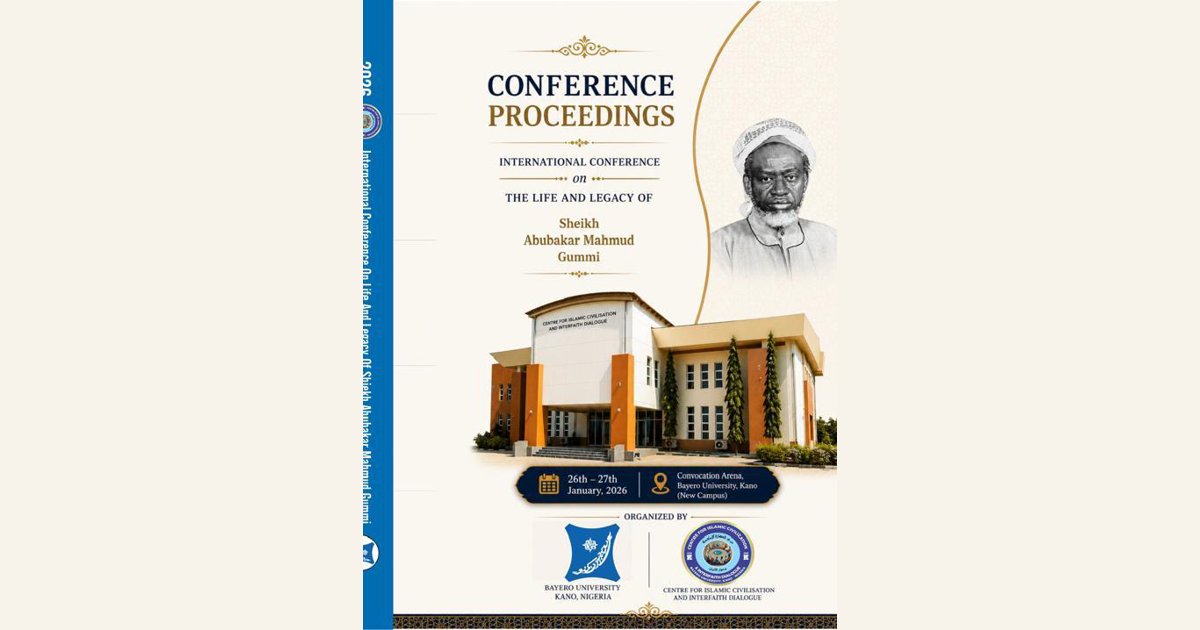
pilgrimage administration. Through his extensive writings, Qur’anic exegesis, translations, and sustained public preaching particularly his annual Ramadan Tafsir Sheikh Gumi articulated a reformist vision aimed at purifying religious practice, correcting social injustices, and aligning Muslim life with the ethical objectives of Shariah. Central to Sheikh Gumi’s reformist project was his sustained engagement with issues affecting Muslim women, which this study examines across multiple domains including political participation, domestic responsibilities, education, modesty, religious obligations, and inheritance rights. In the political sphere, Sheikh Gumi advanced a controversial yet strategic argument for women’s participation in electoral processes, particularly voting and registration, as a means of preventing corrupt leadership and safeguarding the broader religious and moral life of the Muslim community. His rhetorical prioritization of politics over individual acts of worship was grounded in a maqāṣid-oriented understanding of leadership as the mechanism through which religion, life, intellect, lineage, property, and human dignity are protected, a position he justified through Qur’anic principles and historical precedents of women’s political allegiance (bai‘ah) during the Prophet SAW. Within the domestic sphere, Sheikh Gumi articulated a balanced jurisprudential position that rejected the assumption of compulsory domestic labor upon women while acknowledging the role of custom (urf) and ethical virtue in marital cooperation. He emphasized kindness, moderation, and contextual responsibility, drawing upon Prophetic practice to encourage voluntary domestic service without framing it as a rigid legal obligation. Similarly, in matters of religious duty, Sheikh Gumi affirmed women’s independent obligation to perform the first (obligatory) Hajj once conditions are met, even without spousal permission, while recognizing the husband’s rights with respect to voluntary acts of worship. His views demonstrate a nuanced application of Shariah that distinguishes between divine obligations and marital authority in changing social contexts. Sheikh Gumi’s commitment to women’s empowerment was further reflected in his strong advocacy for both Islamic and Western education for women. Through the Izala reform movement, he prioritized structured religious education for married women, recognizing mothers as the primary transmitters of faith and moral values within the family. At the same time, he supported women’s access to Western education, permitting married women to continue schooling without invalidating marital bonds. His position aligns with Qur’anic imperatives of knowledge-seeking and Prophetic practices that allocated specific spaces for women’s instruction, particularly in addressing sensitive religious matters best taught by women themselves. In addition, Sheikh Gumi played a pivotal role in promoting women’s modesty through the institutionalization of hijab, an initiative that initially faced strong resistance but later transformed social norms and enhanced women’s dignity and public respect. Finally, Sheikh Gumi’s reformist jurisprudence is exemplified in his role in safeguarding women’s inheritance rights through judicial intervention. His involvement in appellate cases exposed abuses of customary and emirate authority that contradicted established principles of Islamic inheritance law and judicial impartiality. By restoring property to rightful female heirs and affirming due process, these interventions reinforced the supremacy of Shariah over arbitrary power and highlighted the role of Islamic law as a tool for justice and protection of vulnerable groups. Brief Biography of SheMahmud Gumi His Biography and Education Sheikh Abu Bakribn Mahmud bin Muhammad bin Sheikh Ali, popularly known as Gumi, was born on November 7, 1924, in the Sokoto Province of Northern Nigeria. His early education was deeply rooted in Islamic tradition, beginning at age five under his father's tutelage where he studied the Qur'an, tauhid, fiqh, and hadith. During his youth, he also spent time in Ambursa under Malam Musa, a period he considered a major turning point as it was his first educational pursuit outside his hometown and where he memorized sixteen hizbs of the Qur'an. He successfully graduated from his initial Qur'anic studies in 1936 at the age of twelve. Sheikh Gumi died on 11, September 1992 leaving behind four wives, thirty children and sixty grand children217 His formal academic journey integrated both traditional and Western systems. He attended DogonDaji Elementary School starting in 1933 when he was 9 years old,218 where he was appointed Religious Prefect (HakiminSallah) due to his extraordinary Islamic knowledge. He proceeded to Sokoto Middle School in 1936, graduating in 1942 alongside notable figures like AlhajiShehuShagari. Gumi then pursued advanced studies at the Kano Law School from 1943 to 1947, where he studied a broad range of subjects including tafsir, hadith, and Arabic writing. His education was furthered by international training at the Bakht al-Ridā Institute of Education in Sudan between 1954 and 1956, where he earned a Higher Diploma in Education.219 His Career Sheikh Abubakar Gumi’s professional career began in the judiciary as a Registrar for the Chief Alkali of Sokoto in 1947.220 However, following a brief return to teaching and a period at the Teachers' College in Maru where he formed a lifelong friendship with MalamAminu Kano he transitioned into higher educational and legal roles.221 After receiving advanced training at the Bakht al-Rida Institute of Education in Sudan, he was promoted to Education Officer and
217 Abbas, Usman Sani, The Contribution of ShaykhAbubakar Mahmud Gummi to the Development of Islam in Nigeria, A Journal of Islamic Sciences and Muslim Development, Nigeria, Series 13 and 14, Faculty of Art and Islamic Studies, Department of Islamic Studies, Usman Dan Fodio University, Sokoto, 2015/2016, p.71 218Gumi, ShekhAbubkar&TsigaIsma’ilaAbubakar, Where I Stand, Ibadan Nigeria, Spectrum Books Limited, 2016, p.14 219JangebeHuzaifa, Islamic Reform in Nigeria: The contribution of Sheikh Abubakar Mahmud Gumi, International Journal of Humanities and Social Science, No.9, Gusau, 2015, Vol.5, p.177 220 Abbas, Usman Sani, The Contribution of ShaykhAbubakar Mahmud Gummi to the Development of Islam in Nigeria, A Journal of Islamic Sciences and Muslim Development, Nigeria, Series 13 and 14, Faculty of Art and Islamic Studies, Department of Islamic Studies, Usman Dan Fodio University, Sokoto, 2015/2016, p.72 221 Gumi, ShekhAbubkar&TsigaIsma’ilaAbubakar, Where I Stand, Ibadan Nigeria, Spectrum Books Limited, 2016, p. 44 eventually222 served as the Deputy Grand Khadi before being appointed the Grand Khadi223 of Northern Nigeria in 1963, a position he held until 1975. 224 In his later years, Shaykh Abubakar continued to serve the public through significant administrative roles, including the Chairmanship of the National Pilgrims' Board and the National Teachers' Institute (NTI). Throughout his career, he remained dedicated to religious scholarship, famously conducting yearly Ramadan tafsir sessions starting in 1947. His life reflected a unique blend of traditional Islamic scholarship and formal administrative leadership within the Nigerian state.225 His Works In addition to his administrative leadership, Sheikh Gumi left an extensive literary and religious legacy. He began conducting yearly Ramadan tafsir in 1947 and authored numerous influential books and translations. His most prominent works include Rad al-Azhanila Maani al-Qur'an, his autobiography Where I Stand, and the widely circulated Hausa translation of the meanings of the Glorious Qur'ān (TarjamarMa'anonin al-Kur'aniMaigirma). His scholarly contributions covered diverse disciplines, from the rituals of Hajj and Umrah to contemporary economic values and the fundamentals of Islamic creed.226 Sheikh Gumi's view on women participation in politics: Politics captured the attention of many Muslim scholars in twentieth-century Nigeria, especially as democracy began to shape the nation’s social and political life. Among these scholars, Sheikh Abubakar Mahmud Gumi stood out as a leading reformist who emphasized honesty and integrity in governance. Although deeply concerned with the political unity of Muslims, Sheikh Gumi himself never joined any political party nor authored works on political matters. He once stated, “I cannot do politics, but I can help in choosing a good politician who is fit for leadership.”227 A remarkable aspect of his political reform was his call for Muslim women’s participation in politics, particularly during the 1979 and 1983 general elections. He encouraged Muslim men to allow their wives to register and vote, arguing that political engagement was essential for the Muslim community’s progress. According to Loimeier, the 1979 election was the first time
222 Abbas, Usman Sani, The Contribution of ShaykhAbubakar Mahmud Gummi to the Development of Islam in Nigeria, A Journal of Islamic Sciences and Muslim Development, Nigeria, Series 13 and 14, Faculty of Art and Islamic Studies, Department of Islamic Studies, Usman Dan Fodio University, Sokoto, 2015/2016, p.72 223TsigaIsma’ilaAbubakar, Where I Stand, Ibadan Nigeria, Spectrum Books Limited, 2016, p. 81 224Abbas, Usman Sani, The Contribution of ShaykhAbubakar Mahmud Gummi to the Development of Islam in Nigeria, A Journal of Islamic Sciences and Muslim Development, Nigeria, Series 13 and 14, Faculty of Art and Islamic Studies, Department of Islamic Studies, Usman Dan Fodio University, Sokoto, 2015/2016, p.72 225 Abbas, Usman Sani, The Contribution of ShaykhAbubakar Mahmud Gummi to the Development of Islam in Nigeria, A Journal of Islamic Sciences and Muslim Development, Nigeria, Series 13 and 14, Faculty of Art and Islamic Studies, Department of Islamic Studies, Usman Dan Fodio University, Sokoto, 2015/2016, p.72 226JangebeHuzaifa, Islamic Reform in Nigeria: The contribution of Sheikh Abubakar Mahmud Gumi, International Journal of Humanities and Social Science, No.9, Gusau, 2015, Vol.5, p.178 227JangebeHuzaifa, Islamic Reform in Nigeria: The contribution of Sheikh Abubakar Mahmud Gumi, International Journal of Humanities and Social Science, No.9, Gusau, 2015, Vol.5, p.180
Northern Nigerian women were allowed to vote.228 To justify his stance, Sheikh Gumi coined the phrase “SiyasaTafiMuhimmanchi da Sallah” meaning “politics is more important than prayer.” He further reinforced this view before the 1983 presidential election, saying that elections were even more significant than the pilgrimage (“al-Intikhabatahamm min al-Hajj”).229In his Fatwa Sheikh Gumi explains what he means by these two phrases that is through politics that leadership is established, and it is through leadership that all religious affairs are protected. That is to say it is leadership that manages schools, courts, security and mosques as well as all the affairs of the country230 that is why Allah says in Suratul Hajji: َ﴿ٱلَّذِين إِن ْمَّكَّنََّٰهُم فِى ِٱْلَْرْض أَقَامُوا َٱلصَّلَوَٰة وَءَاتَوُا َٱلزَّكَوَٰة وَأَمَرُوا ِبِٱلْمَعْرُوف وَنَهَوْا ِعَن ِٱلْمُنكَر ۗ َِِّوََّلل ُعََٰقِبَة ﴾ِٱْلُْمُور (سورة ،الحج اآلية ١٤) “And they are those who, if We give them authority in the land, establish prayer and give zakkah and enjoin what is right and forbid what is wrong. And to Allah belongs the outcome of all matters” (Hajji verse 41) The above mentioned verse clearly describes the characteristics and outlines the fundamental duties of righteous leadership. So, it is said that leadership involves protecting six things which are: i. worship in its entirety which consist of kalimatush-shahada, prayer, zakkah, hajj and fasting where leadership protect it so it can be performed well by sponsoring teachers and imams that will teach the citizens how to perform them well because it is not enough just to do it without knowing how to do it because worship cannot be perform without being taught. ii. Protection of lineage. That is the protection lineage through marriage as prescribe by the Shariah for example in the past, years ago people used to give their daughters as a gift (sadaka) for marriage. How can a person gift out what he did not own? (You see then, this was just committing adultery without knowing it). iii. Protection of property\ wealth, which consist of preventing thieves, armed robbers, criminals, frauders, those who cheat and those who deceive. iv. Protection of lives, that is to ensure that no one’s blood is shed and punish anybody that committed such act. v. protection of intellect\ minds. This protects the citizen from anything that causes intoxication or loss of intellect is prohibited because if intellect is not protected, that is what leads people to drink alcohol, get into car accidents and die. Protecting this intellect is entirely the work of politicians because it is through leadership that is protected. vi. Protection of dignity\honor. It is through leadership that people’s dignity is protected for instance if somebody accuses someone of adultery, a legal judgment must be made to protect them. So that it is not said that this somebody is an illegitimate child.231 The above mentioned six aspects are what politics protects and hajj is under one aspect among the six aspects which is Ibadah (worship) and by casting vote a citizen can choose person of
228 Roman Loimieier, Islamic Reform and Political Change in Northern Nigeria, U.S, Northwestern University press, 1997, pp. 166-167 229 Interview with Sheikh Gumi, GaskiaTafiKwabo (Truth is better than penny), Newspaper, May 1983 230Funtuwa, Musa Lawal, FatawarAbubakar Mahmoud Gumi (SabonTsari), Zaria: Hudahuda publishing company, 2nd Edition, 1996, Vol.2, p.171 231Funtuwa, Musa Lawal, FatawarAbubakarMahmoud Gumi (SabonTsari), Zaria: Hudahuda publishing company, 2nd Edition, 1996, Vol.2, pp 164-166 integrity who will stand up to ensure all these things are protected including the pilgrimage itself and when a person leave it and go to his pilgrimage, allowing those who are not good to prevail, how do he think it will not affect the rest of his religious affairs? Is it not possible that before he return from the pilgrimage, his religion will have been greatly harmed?232 By looking at Sheikh Gumi’s explanation, he did not literally mean that politics is better than prayer or Hajj, but rather he was trying to show the importance of women’s participation in politics to prevent corrupt leaders. sheikh Gumi’s call for women’s participation in political processes (voting, registering and being part of democratic mobilisation) in the Nigerian context can be seen as a significant effort to prevent the rise of corrupt politicians and he uses these phrases because they the thing that everybody know their important among the Muslim that is if he uses something other than this some people will not understand how important it is. Because if there is no good government, citizens will not be free to perform their religious activities, not even prayer or Hajj. Let’s take an example during the “Boko Haram” insurgency some years back, when people were afraid to perform congregational prayer in the mosque, and the unnecessary increase in Hajj fares, among others. It is only a just leader who will be concerned about the well-being of his citizens. Let take an example during the time Sardauna when him and sheikh Gumi went for hajj when Sheikh went out for a short walk in the direction of the jamarats, (where the symbolic stones were cast) and was shocked when he observed how some Nigerian pilgrims were throwing huge pieces of stones, shoes or any other thing they could fine in the name of stoning the devil. Also, few among them mounted a small mound at the jamarats, hitting it with sticks and shouting insults again the Satan (Iblis) at the same time. By observing this, he went back and quickly invited Sardauna so that he could what his own people are doing which was very shameful, especially in front of international community and asked Sheikh Gumi for a solution and he told the only solution is to educate them and Sardauna accepted his advice after their returned, Sardauna employed three teachers on full-time basis that will be going round educating people about the religion and undertook to give each five pounds monthly and sheikh Gumi suggested that the teachers should be five were the Sardauna agreed then sheikh Gumi added two teachers and sponsored them himself.233 By looking at the above example one can easily understand the reason behind sheikh Gumi’s advocacy for women participation in politics because if not Sardauna is a good leader he will not be even concerned on the citizens to the extent that he will sponsor teachers that will teach them their religion and people will be going to hajj without having the knowledge of how the hajj will be perform. So now, let imagine the leader is not someone like Sardauna or he is not even a Muslim what will happen is that people will just be worshiping Allah out of ignorance and leaders will not care.
232Funtuwa, Musa Lawal, FatawarAbubakar Mahmoud Gumi (SabonTsari), Zaria: Hudahuda publishing company, 2nd Edition, 1996, Vol.2, pp.166 233Gumi, ShekhAbubkar&TsigaIsma’ilaAbubakar, Where I Stand, Ibadan Nigeria, Spectrum Books Limited, 2016, pp.104-105
Based on the above Sheikh Gumi’s call for women’s participation in electoral politics (voting, registration) aligns well with the general permissive view in Shariah that women can engage in politics as their fundamental right. Even though Sheikh Gumi did not directly based his view with any source of the Shariah but it does contradict women to participate in the politics as women did bai’ah (pledge of allegiance) during the time of the prophet (SAW) although democracy is not the same thing with bai’ah but it can be use as the general rule. Allah explicitly mentions women giving bai‘ah (pledge of allegiance) to the Prophet (SAW) in the Qur’an:
َ﴿يَََٰٰٓأَيُّهَا ٱلنَّبِىُّ إِذَا جَآَٰءَكَ ٱلْمُؤْمِنََٰتُ يُبَايِعْنَكَ عَلَىََٰٰٓ أَن الَّ يُشْرِكْنَ بِٱَّللَِّ شَيْـ ًۭٔا وَالَ ي سْرِقْنَ وَالَ يَزْنِينَ وَالَ يَقْتُلْنَ أَوْلََٰدَهُنَّ وَالَ يَأْتِينَ بِبُهْتََٰنٍٍۢ يَفْتَرِينَهُۥ ََّبَيْنَ أَيْدِيهِنَّ وَأَرْجُلِهِنَّ وَالَ يَعْصِينَكَ فِى مَعْرُوفٍٍۢ ۙ فَبَايِعْهُنَّ وَٱسْتَغْفِرْ لَهُنَّ ٱَّللََّ ِ نَّ ٱَّلل : غَفُور ًۭٔ رَّحِيم ًۭٔ﴾ الممتحنة ٢١. “O Prophet! When believing women come to you to give you the pledge (bai‘ah), that they will not associate anything with Allah, nor steal, nor commit fornication, nor kill their children, nor slander, nor disobey you in what is right then accept their pledge and ask Allah to forgive them. Indeed, Allah is Forgiving and Merciful.” Surah Al-Mumtahanah (60:12) The above verse shows that women directly pledged allegiance to the Prophet recognizing his leadership and committing to obey him in righteousness. This was an official act of political and moral participation in the Muslim community and bai’ah is not directly as democratic election but can it can be consider as general permissibility of women on politics. The second pledge at Al-‘Aqabah (622
َ﴿وَّلِلَََّ عَلَى ٱلنَّاسَ حَجُّ ٱلْبَيْتَ مَنَ ٱسْتَطَاعَ إَلَيْهَ سَبَيًلًا ۚ وَمَن كَفَرَ فَإَنَّ ٱّلِلََّ غَنَىٌّ عَنَ ٱلْع ﴾َلَمَين
:آل عمران ٧٩ . “And Hajj to the House is a duty that mankind owes to Allah for whoever is able to find a way thereto.” ( ĀlʿImrān 3:97) By looking at the above mentioned verse, a husband did not have right to stop his wife from performing first because it is an obligatory act as prayer which is a pillar among the pillars of
240Al Bukhari, Muhammad bin Isma’il, translated by Muhammad Muhsinkhan, The translation of the meaning of Sahih Al-Bukhari, Saudi Arabia: Darussalam Publishers and Distributors, 1997, Vol.7, p, No,324 241Funtuwa, Musa Lawal,FatawarAbubakar Mahmoud Gumi (SabonTsari), Zaria: Hudahuda publishing company, 2nd Edition, 1996, Vol.2, p.99
Islam, Muslim a woman should perform her obligatory hajj as soon as possible just as she should offer her prescribed daily prayers at their earliest prescribed times with or without the consent of her because it is unlawful to obey anyone in something that involves disobedience to Allah. Also, once the first (obligatory) Hajj has been performed, any additional pilgrimage becomes voluntary (nafl). In this case, the husband’s right of companionship and marital duties take precedence over voluntary acts of worship. Concerning the view of Sheikh Gumi view for the trustworthy group men, women or both this fatwa should be applied to the women of those days when pilgrims would spend many days before reaching Makkah. Islam has forbidden a woman to travel for more than three days without her mahram, but today, a person can travel from here to Makkah within hours, not even a day. Also, the Hajj commission is taking care of them. Some contemporary scholars like Yusuf al-Qardawi is of the view that security and protection are the main ruling on the women not to travel alone. He emphasizes that security must be granted before woman can travel alone, but if security is not guaranteed, then she must be monitored by some trusted men or trusted women.242 Also traveling today is not the same as traveling in the past that was fraught with dangers like being robbed by arm robbers and passing through deserts. Traveling today involves using means of transportations that can accommodate many people, like airplanes, ships and buses.243 Sheikh Gumi's view on women’s right to education: In February 1970, the Islamic reform movement “Jama’atul Izalatul Bid’a wa Iqamatus Sunnah,” of which Sheikh Abubakar Gumi was among the leading scholars in Kaduna, emphasized the importance of Islamic education for both girls and married women of all ages. He gave priority to the education of married adult women, known as (IslamiyyahMatanAure), where they were taught the Qur’an and Hadith which were a critical for rising up proper children.244 Despite the number of chapters in the Qur’an that emphasize the important of seeking knowledge, yet the ability to read Qur’an and other Islamic texts are learn through these Islamiyyah classes. Izala leaders and teachers made more emphases on the importance of this training not only for Islamic education but also, for moral education which emphasis were placed on women’s domestic roles as wives, mothers.245 This reform changed the lives of many married women where women have lent ideological support to new behaviors, which included the wearing of the new introduced form of body covering, hijab when going for Islamiyyah classes246 Sheikh Gumi was not only concerned with Islamic education, but he also supported women’s Western education, holding the view that a newly married wife can stay in her father’s house
242DarmawanAldy, NurulIzzati, Hajj and Umrah Travel for Women Without Mahram, Moefty: Journal PerbandiganMazhabdanHukum, Indonesia, Imam Bonjol State Islamic State University Padang, 2024, Vol.13 P.7 243DediSyarial, &Yui’atri Sri, Imam Ash-Shafi’i’s Opinion on Hajj without a Mahram and Its Relevance to the presence Day, Al Istinbath Journal Islam, Number 2, Indonesia, 2023, Vol.8, p.550 244Funtuwa, Musa Lawal, FatawarAbubakar Mahmoud Gumi (SabonTsari), Zaria: Hudahuda publishing company, 2nd Edition, 1996, Vol.2, p. .127 245Funtuwa, Musa Lawal, FatawarAbubakar Mahmoud Gumi (SabonTsari), Zaria: Hudahuda publishing company, 2nd Edition, 1996, Vol.2, p. 128 246Funtuwa, Musa Lawal, FatawarAbubakar Mahmoud Gumi (SabonTsari), Zaria: Hudahuda publishing company, 2nd Edition, 1996, Vol.2, p. 130 after marriage to finish her Western education (makarantarboko), and the marriage remains valid, or she may continue while staying in her husband’s house.247 By looking at the above, Sheikh Gumi’s view on women’s education shows the importance of educating women as the backbone of every family who trains the children, because a mother is the first teacher of every child. If she is not educated islamically, what will she teach her children? How can she train them based on Islamic morals and values? Also, an illiterate wife does not know her husband’s rights and duties toward her, as well as her own toward him. However, as Sheikh gave fatwa on Western education, there is no restriction on seeking knowledge because the first verse of suratul Alaq “ ْاقْرَأ” refers to every aspect of knowledge. Also, among the importance of women’s education is that they can teach their fellow women (source), because there are some sensitive issues that a woman may be shy to ask a man, but if the teacher is also a woman, she will feel free to discuss it. Let trace back to history during the time of the Prophet SAW there are some certain issues that he cannot explain it because he was shy. For example in the following Hadith: It was narrated from Aisha that a woman asked the prophet SAW about performing Ghusl following menstruation and he told her how to perform Ghusl. Then he said: “Take a piece of cloth perfumed with musk and purify yourself with it” She said: “Hoe should I purify myself with it?” He covered his face then said: “Subhan Allah Purify yourself with it.” Aisha said: “I took the woman aside and said: Wipe away the traces of the blood with it.”248 The above mentioned tradition clearly shows how women education is important because there some sensitive issues that a man will feel shy to explain it to a woman and also must of the woman are performing religious affairs out of ignorance because they cannot ask a man but if a woman is asking her fellow woman she will feel free to ask her and she will receive her answer accordingly. In another Hadith that was narrated from Abu Sa’id Al-Khudri (RA): “Some women requested the prophet SAW to fix a day for them as the men were taking all his time. On that he SAW promised them one day for religious lessons and commandments. Once during such a lesson the prophet SAW said, “A woman whose three children die will be shielded by them from the Hellfire.” On that a woman asked, if only two die? He replied, Even two (Will shield her from the Hell-fire).”249 The above prophetic tradition shows that even during the time of the prophet SAW women were giving time by the prophet SAW himself to educate them which show how women education is important. Sheikh Gumi's view on Women’s Modesty: The Glorious Qur’an and Ahadith of the Prophet (SAW), women were enjoined to cover their bodies. Sheikh Abubakar Gumi, as a leading scholar of Jama’atulIzalatulBid’awaIqamatusSunnah,
247Funtuwa, Musa Lawal, FatawarAbubakar Mahmoud Gumi (SabonTsari), Zaria: Hudahuda publishing company, 2nd Edition, 1996, Vol.1, pg. 66 248Muslim bin al-Hajjaj, AbulHussain, English Translation of Sahih Muslim, Edited by Nasiruddin al-Khattab (Canada), Darussalam Global Leaders in Islamic Books, King Fahad National Library Catalog –in-Publication Data Al-Imam Muslim, 2007, p444, vol.1, No 332. 249Al Bukhari, Muhammad bin Isma’il, translated by Muhammad Muhsinkhan, The translation of the meaning of Sahih Al-Bukhari, Saudi Arabia: Darussalam Publishers and Distributors, 1997, Vol.1, pp. 115-116, No.101 contributed greatly to promoting women’s modesty by introducing a distinctive dress for women called hijab (a sewn, loose cloth from head to toe) in his College of Higher Islamic Studies.250 When hijab was introduced people say a lot of bad things against it where women that are wearing hijab being called names, like “Tazarce” (like a long robes worn by the former president Sani Abacha), Some would say “rakatajahannama” (it will escort her to hell) and there is a name that was even referred to Sheikh Gumi being as “Takunkumin Gumi.” (Shackles of Gumi). These are the kind of things that happened to those who wore hijab251 This Izala reform, in which Sheikh Gumi was among the leading scholars, has impacted the lives of northerners and even some parts of southern Nigeria, because it is not only the Izala group that uses hijab; almost every sect now adopts it. It has also reduced immoral behavior in society and brought respect for women to the extent that a man cannot confront a lady wearing hijab. Ladies now feel free and confident wearing it without fear that any part of their body is exposed. Sheikh Gumi and the Protection of Women’s Inheritance Rights: There was a case of a lady from Kano which appealed in respect of a judgment given in the Emir’s court that her father died that her leaving behind a house which the family lived and some other property and the emir confiscated the house claiming that the man was his slave so he house belong to him. The family protested but was in vain, so the daughter was secretly assisted by some NEPU officials to appeal in Kaduna. After necessary processes, the case was considered to appeal. The person who presented Kano NA was an imam of Madawaski’s house mosque who was also a member of the Emirate council. Where he answered that the house belongs to the deceased father of the girl but the man was an Emir’s slave. The court asked him on he come to be his slave and he answered that because he was once belong to Emir Abbas who is the Grandfather of the present Emir which he inherited the slave from him. After that the court passed judgment the Emir cannot inherit any property directly from his grandfather while his children are still alive because according to the Shariah a grandchild can only inherit his grandfather if he have no living children of his own. Also, a judge is not allowed to try a case which he is involved as a party to the dispute, if the emir had any claims against the deceased property, the correct approach him was to go to another court and establish claims in accordance with the terms of the law and he have to established evidence whether the dead person was ever a slave then there is no option but to rule that the young lady should be given back her deceased father’s property.252 This case demonstrates the contribution of sheikh Gumi on how appellate judicial intervention can protect women’s inheritance rights against the misuse of customary and emirate authority. The confiscation of the deceased father’s property on the basis of an unproven claim of slavery violated established principles of Shari'ah law, particularly the rules of inheritance and judicial impartiality. The appellate court correctly held that a grandchild cannot inherit from a
250Funtuwa, Musa Lawal, FatawarAbubakar Mahmoud Gumi (SabonTsari), Zaria: Hudahuda publishing company, 2nd Edition, 1996, Vol.2, p.122 251Funtuwa, Musa Lawal, FatawarAbubakar Mahmoud Gumi (SabonTsari), Zaria: Hudahuda publishing company, 2nd Edition, 1996, Vol.2, PP.130-131 252Gumi, ShekhAbubkar&TsigaIsma’ilaAbubakar, Where I Stand, Ibadan Nigeria, Spectrum Books Limited, 2016, pp.83-84 grandfather while the grandfather’s children are alive and that no judge may adjudicate a case in which he has a personal interest. By overturning the Emir’s court judgment and restoring the property to the deceased’s daughter, the court upheld due process, reinforced the supremacy of Islamic legal principles over arbitrary authority, and affirmed women’s lawful right to property and access to justice within a plural legal system. Conclusion In conclusion, this study demonstrates that Sheikh Abubakar Mahmoud Gumi was a pioneering Islamic reformer whose scholarly legacy reflects a deliberate effort to harmonize classical Islamic jurisprudence with the socio-political realities of twentieth-century Northern Nigeria, particularly in matters concerning women. Through his biography, education, career, and extensive writings, Sheikh Gumi emerges as a scholar deeply rooted in traditional Islamic learning yet responsive to modern governance and social challenges. His views on women’s participation in politics reveal a maqāṣid-oriented understanding of Shariah, wherein political engagement especially voting was emphasized as a means of safeguarding religion, justice, and public welfare rather than as a literal prioritization over acts of worship such as ṣalāh or ḥajj. Similarly, his positions on women’s domestic responsibilities underscore compassion, contractual consent, and customary considerations, rejecting the notion that household labor is an absolute religious obligation upon women. His fatwas on women’s right to education, both Islamic and Western, affirm his recognition of women as the moral and intellectual foundation of the family and society, while his advocacy for women’s access to obligatory ḥajj highlights the supremacy of divine commands over spousal authority in matters of compulsory worship. Furthermore, his promotion of women’s modesty through the institutionalization of hijab and his judicial interventions to protect women’s inheritance rights illustrate his commitment to dignity, justice, and legal due process within the framework of Shariah. Overall, the findings of this study establish that Sheikh Gumi’s engagement with women’s issues was neither reactionary nor superficial, but rather a coherent reformist project grounded in Islamic legal principles, ethical responsibility, and societal welfare, offering a significant and enduring contribution to contemporary debates on Islam, gender, and governance in Muslim societies. Bibliography Abbas, Usman Sani, The Contribution of ShaykhAbubakar Mahmud Gummi to the Development of Islam in Nigeria, A Journal of Islamic Sciences and Muslim Development, Nigeria, Series 13 and 14, Faculty of Art and Islamic Studies, Department of Islamic Studies, Usman Dan Fodio University, Sokoto, 2015& 2016.
Al-Mubarakpuri, Safiur-Rahman, The Sealed Nectar, Riyadh, Darussalam Global Leader in Islamic Books, Revised edition, 2002.
Al Bukhari, Muhammad bin Isma’il, translated by Muhammad Muhsinkhan, The translation of the meaning of Sahih Al-Bukhari, Saudi Arabia: Darussalam Publishers and Distributors, 1997.
DarmawanAldy, NurulIzzati, Hajj andUmrah Travel for Women Without Mahram, Moefty: Journal PerbandiganMazhabdanHukum, Indonesia, Imam Bonjol State Islamic State University Padang, 2024.
DediSyarial, &Yui’atri Sri, Imam Ash-Shafi’i’s Opinion on Hajj without a Mahram and Its Relevance to the presence Day, Al Istinbath Journal Islam, Number 2, Indonesia, 2023.
Funtuwa, Musa Lawal, FatawarAbubakar Mahmoud Gumi (SabonTsari), Zaria: Hudahuda publishing company, 2nd Edition, 1996.
Gumi, ShekhAbubkar&TsigaIsma’ilaAbubakar, Where I Stand, Ibadan Nigeria, Spectrum Books Limited, 2016.
Interview with Sheikh Gumi, GaskiaTafiKwabo (Truth is better than penny), Newspaper, May 1983
JangebeHuzaifa, Islamic Reform in Nigeria: The contribution of Sheikh Abubakar Mahmud Gumi, International Journal of Humanities and Social Science, No.9, Gusau, 2015.
Muslim bin al-Hajjaj, AbulHussain, English Translation of Sahih Muslim, Edited by Nasiruddin al-Khattab (Canada), Darussalam Global Leaders in Islamic Books, King Fahad National Library Catalog –in-Publication Data Al-Imam Muslim, 2007.
Roman Loimieier, Islamic Reform and Political Change in Northern Nigeria, U.S, Northwestern University press, 1997.
Comments