
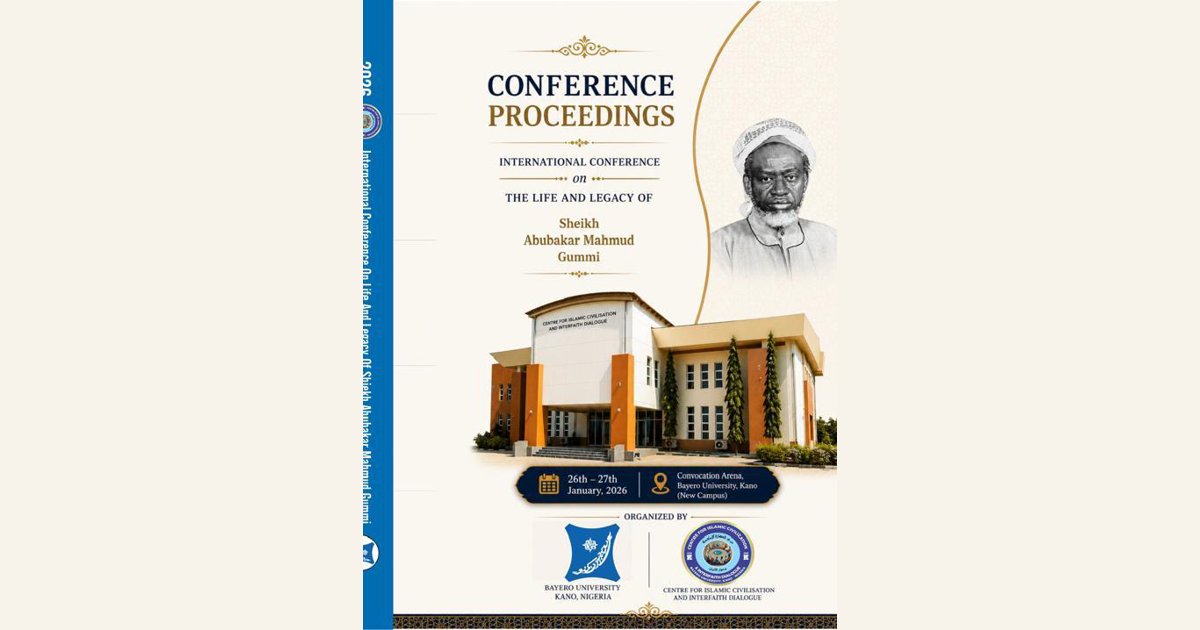
In the Nigerian context, Sheikh Abubakar Mahmud Gumi (1924–1992) remains one of the most prominent Sunni scholars who embodied these values. A former Grand Khadi of Northern Nigeria, close associate of political leaders, and international Islamic ambassador, Sheikh Gumi chose a humble and simple life despite his influence. His legacy is not restricted to his scholarship and writings but also includes his ethical conduct, specifically his rejection of material excess and worldly pride (Ibrahim, 2006).. This paper explains the role of zuhd and simplicity in Sheikh Abubakar Gumi’s life and how these values serve as guiding principles for Nigerian Islamic scholarship. It seeks to address the problem of declining ethical standards, materialism, and the erosion of moral authority among contemporary scholars. By drawing lessons from Sheikh Gumi’s example, the study proposes practical ways to restore sincerity, integrity, and credibility to Islamic scholarship in Nigeria. The study therefore, concentrated on the following objectives: i. To examine the concept of zuhd from a Sunni Islamic perspective. ii. To analyze how Sheikh Abubakar Gumi embodied simplicity and asceticism in his life. iii. To assess the relevance of his legacy to contemporary Nigerian Islamic scholarship. iv. To propose policy and educational implications for sustaining ethical scholarship. To achieve the said objectives the study employs a qualitative and descriptive approach, focusing on interpretive analysis. Data is derived from three main sources: a. Primary Islamic Sources: The Qur’an and Hadith on zuhd and simplicity. b. Classical Sunni Scholarship: Works by al-Ghazali, Ibn al-Qayyim, and others that contextualize zuhd. c. Secondary Literature: Biographies and academic studies on Sheikh Gumi, as well as works on Nigerian Islamic scholarship. The method involves textual analysis of these sources and thematic synthesis to derive lessons for contemporary Nigerian scholarship. 2. Concept of Zuhd in Sunni Islam Az-Zuhd is the opposite of being eagerly concerned about the dunya (the life of this world)." Ibn al-Qayyim said, "Az-Zuhd, in the Arabic language, the language of Islam, entails abandoning a matter while despising it and belittling its significance, so that one will exchange it for what is more significant.." (Abū Nuʿaym, 1996). The Muslim progenitors who exemplified the principles of Islam exhibit a myriad of interpretations concerning the essence of az-Zuhd. Ibn al-Qayyim, for instance, recounted, "I heard Shaykh ul-Islam ibn Taymiyyah articulate, 'Az-Zuhd encompasses the relinquishment of pursuits that yield no advantage in the Hereafter. Al-Wara'(the abstention from certain permissible matters due to apprehension of transgressing into the impermissible) involves forsaking that whichone fears may have detrimental repercussions in the Hereafter.'"Subsequently, Ibn al-Qayyim remarked, "This pronouncement stands as one of the most profound and all-encompassing definitions of az-Zuhd and al-Wara'."(SunnahOnline, n.d.).
In addition, Sufyan ath-Thawri said, "Az-Zuhd in this dunya entails reducing hope (or avoiding having hopes that one will live long), not by wearing thick clothes or the garment (as some people who observe fake zuhd think is a part of az-Zuhd).." (Al-Dhahabi, 1999). In the Qur’an, believers are reminded that “the life of this world is but amusement and diversion, and the Hereafter is better for those who fear Allah” (Qur’an 6:32). Prophet Muhammad ﷺ also warned against excessive attachment to worldly possessions, teaching his companions to live modestly (al-Bukhari, 1997). Sunni scholars such as Hasan al-Basri, Imam Ahmad ibn Hanbal, and later Imam al-Ghazali emphasized zuhd as a balance: avoiding material excess while fulfilling worldly responsibilities (al-Ghazali, 1993). Classical works such as Ibn al-Qayyim’s Madarij al-Salikin (1996) stress that zuhd is not mere poverty but the detachment of the heart from worldly greed.. This aligns with Sheikh Gumi’s approach: though positioned in high offices, he remained humble, self-disciplined, and detached from materialism. 3. Islamic Scholarship and Ethics in Nigeria It is imperative to elucidate the connection between ethics and religious scholarship for the purpose of clarification and emphasis. Ethics, in essence, constitutes a systematic examination and assessment of human actions and intentions to ascertain their moral quality—be it goodness or badness, rightness or wrongness, correctness or incorrectness (Kehinde, 2010). Islamic scholarship in Nigeria boasts a rich tradition that traces back to the Sokoto Jihad of 1804, led by Sheikh Uthman dan Fodio. His writings underscored the virtues of simplicity, humility, and sincerity (ikhlas) as fundamental prerequisites for genuine scholarship (Last, 1967). Nevertheless, contemporary Islamic education in Nigeria grapples with formidable challenges, including the commercialization of knowledge, the politicization of religious authority, and the erosion of moral integrity (Loimeier, 1997). Studies by Hunwick (1992) and Kane (2003) highlight how West African Islamic scholarship historically relied on personal credibility and moral authority rather than institutional power. This makes the example of figures like Sheikh Gumi critical for restoring trust in scholars today. 4. Sheikh Abubakar Gumi’s Legacy Sheikh Abubakar Mahmud Gumi (1924–1992), was a great and learned Islamic scholar who impacted his community and served as an inspiration to subsequent scholars. His birth took place in a well-established family with a good Islamic education. His father always gave him the greatest care possible when he was growing up in their custody. He was therefore afforded sufficient opportunity to exhibit his expertise and express his views on several topics (Aliyu, 2015). 4.1 Educational Background Sheikh Abubakar Gumi began his early education under his father, Malam Mahmud Na Gumi, memorizing the Qur’an and studying key Maliki jurisprudence texts such as Risalah of Abi Zaid al-Qirawani in a traditional Makarantar Allo. In 1933, at age nine, he started Western education at Dogon Daji Elementary School, where his strong Islamic background earned him the role of
Hakimin Sallah (Religious Prefect). His exceptional performance led to rapid promotion to Standard Two after just one term (Aliyu, 2015). After one year, he moved to Sokoto Middle School (now Sultan Ward Primary School), where he studied for six successful years. He later proceeded to the Kano Law School, combining legal and private studies. Upon completing his law education, he returned to Sokoto for public service before furthering his studies at the School for Arabic Studies, Kano, earning a Higher Elementary Training Certificate in 1952. Due to his outstanding results, he was sponsored to the Bakht al-Rida Institute of Education in Sudan (1955–1956), where he obtained a Higher Diploma in Education (Aliyu, 2015). Sheikh Abubakar Gumi, while studying for his Advanced Diploma in Education at the Bakht al-Rida Institute in Sudan, described his experience as enjoyable and enriching. He studied education principles, Arabic, history, mathematics, English, and drawing, with Arabic and English as the languages of instruction. During his teaching practice, he taught at Madrasah al-Ahfad in Omdurman, near Khartoum. Beyond formal education, Gumi continued to learn privately from many renowned scholars, becoming a prominent and authoritative Islamic scholar with deep and broad knowledge in Islamic sciences (Aliyu, 2015). 4.2 Career Despite British colonial dominance, Gumi’s exceptional ability earned him several important public roles. After graduating from law school, he worked as a scribe in the office of the Chief Judge of Sokoto Province. In 1956, the Sardauna of Sokoto appointed him as the first Nigerian Pilgrims’ Officer to the Holy Land. He later became Deputy Grand Qadi of Northern Nigeria (1960) and then Grand Qadi (1962–1967) (Aliyu, 2015). He also served on the management board of King Faisal Bank (founded in 1976) and as a member of the supreme councils of several major universities, including the Islamic University of Madinah, Ahmadu Bello University (Zaria), and the University of Ibadan (Aliyu, 2015). 4.3 Educational contributions Sheikh Gumi was a prolific writer, leaving behind numerous books, booklets, articles, and manuscripts. His notable newspaper writings appeared in the Nasiha Series, Gaskiya Ta Fi Kwabo, Triumph, and New Nigeria since 1970. His well-known publications include: 1. Rad al-Azhan ila Ma‘ani al-Qur’an (Return of the Intellect to the Meaning of the Qur’an) 2. Al-‘Aqidah al-Sahiha bi Muwafaqat al-Shari‘ah (The Correct Belief in Line with Islamic Law) 3. Kitab al-Nasihah ila Amir Mantiqat Katsina (Advice to the Emir of Katsina) 4. Where I Stand (co-authored with I. A. Tsiga) 5. Hal al-Niza‘ fi Mas’alat Nuzul ‘Isa (Resolving the Dispute on the Descent of Prophet Jesus) 6. Musulunci da Abin da ke Rushe Shi (Islam and What Nullifies It) 7. Zad al-Hajj (Provision for the Pilgrim) 8. Maratib al-Islam (Levels of Islam) 9. Manasik al-Hajj wa al-‘Umrah (Rituals of Hajj and ‘Umrah) 10. Tarjamar Ma’anonin al-Kur’ani Maigirma (Translation of the Meanings of the Glorious Qur’an) 11. Tarjamar al-Arba‘in al-Nawawiyyah (Translation of Forty Hadith)
12. Tarjamar Kitab Nur al-Bab (Translation of Nur al-Bab) 13. Tarjamar Hidayat al-Tullab fi Aham Masail al-Din (Translation of The Students’ Guide to Key Religious Matters) He also left unpublished manuscripts, including Qiyam fi al-Iqtisad al-Mu‘asir wa al-Ta‘amul ma‘a al-Bunuk (Values in the Contemporary Economy and Dealings with Banks) and a translation of Usul al-Din (Fundamentals of Religion) (Aliyu, 2015). 4.4 Lifestyle Biographical works (Ibrahim, 2006; Loimeier, 1997) provide a detailed account of Gumi's life, portraying him as a dedicated reformer deeply rooted in Sunni orthodoxy and simplicity. Gumi's commitment to zuhd, or asceticism, was not merely theoretical but reflected in his everyday actions. For instance, he led a humble life, shunning extravagance and opting for a modest lifestyle that resonated with his beliefs. Moreover, Gumi's choice to prioritize public service over personal gain underscored his selfless nature and genuine concern for the welfare of others. In his renowned works such as Al-Aqidah al-Sahihah bi Muwafaqat al-Shari‘ah and Where I Stand, Gumi emphasized the importance of sincerity in both faith and leadership. Through his writings, he sought to instill in his readers the values of honesty, integrity, and devotion to God. Gumi's moral authority was not solely derived from his scholarly knowledge but also from his embodiment of zuhd in his own life. This exemplified his authenticity and made him a respected figure, revered as a role model by Muslims in Nigeria and beyond(Ibrahim, 2006; Loimeier, 1997) Another component of Sheikh Gumi's ethical leadership philosophy was the principle of accountability. Leaders must understand their accountability to their followers and, ultimately, to God, according to Gumi. Sheikh Gumi is adamant about upholding integrity and honesty. He emphasized that leaders have to be truthful, dependable, and honest in both their words and deeds. The Qur'an states, "O you who have believed, fear Allah and speak words of appropriate justice" (Qur'an 33:70), which was consistent with this position. Gumi believed that a leader's credibility and dependability came from their honesty. The core of Sheikh Gumi's beliefs regarding moral leadership was the concept of God-consciousness, (taqwā) (Muhammad & Umar, 2025). 5. Findings and Discussion: i. Simplicity in Lifestyle: Sheikh Abubakar Gumi was known not only for his remarkable simplicity in lifestyle but also for his unwavering commitment to humility amidst the temptations of affluence and power. His choice of modest attire, humble residence, and daily routines reflected a profound understanding that true leadership does not lie in extravagant displays of wealth, but rather in the embodiment of moral principles. By shunning ostentation, Sheikh Gumi exemplified the timeless truth that genuine authority stems from moral integrity rather than material possessions (Ibrahim, 2006). As it is clearly stated in the glorious Qur'an: And give the relative his right, and [also] the poor and the traveller, and do not spend wastefully. (Qur’an 17:26 ). The above verse explains that a good Muslim is expected to live a simple life. Therefore, the lifestyle of late Abubakar Mahmud Gumi was in accordance with the teaching of the Qur'an.
ii. Zuhd as Spiritual Discipline: Gumi's practice of zuhd was not a mere rejection of worldly pleasures but a disciplined approach to engaging with the world while upholding justice and fairness as the Grand Khadi. His unwavering commitment to integrity and resistance to corruption were in alignment with the teachings of Sunni scholars, who emphasize that zuhd is primarily about detachment of the heart rather than a complete abandonment of worldly responsibilities (al-Ghazali, 1993). In respect of spiritual discipline, Allah says: Know that the life of this world is only play, amusement, decoration, boasting among you, and competition in increase of wealth and children. It is like rain whose growth pleases the tillers; then it dries and you see it turn yellow; then it becomes [scattered] debris. And in the Hereafter is severe punishment and forgiveness from Allah and approval. And what is the worldly life except the enjoyment of delusion. (Qur'an 57:20) The above verse encourages detachment from worldly excesses, a core principle of zuhd. In another verse Allah the Almighty explained: Competition in [worldly] increase diverts you until you visit the graves." (Qur'an 102:1–2) This verse reminds us that worldly pursuits are transient, therefore, Muslims should not be deceived by the luxury of this world. Furthermore, it has been narrated from Ibn ‘Abbas (R.A) that the Prophet S.A.W said: The world is a prison for the believer and a paradise for the disbeliever." (Sahih Muslim, Book 42, Hadith 7051) The above Hadith emphasizes detachment from worldly pleasures as a form of spiritual discipline. In another Hadith from Abu Hurairah (RA), the Prophet S.A.W. said: Be in this world as if you were a stranger or a traveler. (Sahih al-Bukhari, Hadith 6416) The above Hadith encourages minimal attachment to worldly possessions, as a key aspect of zuhd. iii. Credibility in Scholarship: The credibility that Sheikh Gumi commanded among ordinary Muslims was a result of his life being a living testament to the values he preached. In stark contrast, the contemporary Nigerian scholarly landscape is often plagued by credibility crises stemming from materialistic pursuits and political compromises (Loimeier, 1997). Sheikh Gumi's example serves as a poignant reminder of how simplicity and integrity can enhance trust in scholars and their teachings. Allah explained in the glorious Qur'an: Do not follow that of which you have no knowledge. Indeed, the hearing, the sight, and the heart all of these will be questioned. (Qur’an 17:36) Meaning that, scholars are accountable before Allah for what they teach; they must not speak without sound evidence or knowledge. In the following verses Allah says: Indeed, those who conceal what We sent down of clear proofs and guidance after We made it clear for the people in the Scripture, those are cursed by Allah and cursed by those who curse. (Qur’an 2:159)
The above verse explains that withholding or distorting knowledge is a grave betrayal of scholarly trust, while the following verse states that: O you who believe! Be steadfast for Allah, witnesses in justice. (Qur’an 5:8) Meaning that, credible scholarship requires fairness, objectivity, and honesty, even when it contradicts one’s desires or affiliations. Furthermore, below are some Prophetic Hadiths that encourage credibility in scholarship: The Prophet (S.A.W)said: May Allah brighten the face of the one who hears my words, understands them, and conveys them exactly as he heard them.” (Sunan al-Tirmidhī, Hadith no. 2656) The above Hadith means that, true scholarship preserves accuracy and avoids distortion in conveying knowledge In another Hadith , the Prophet (S.A.W) said: Whoever intentionally lies about me, let him take his seat in Hellfire. (Ṣaḥīḥ al-Bukhārī, Hadith no. 107) The above Hadith highlights that, scholarly credibility requires strict truthfulness — false attribution or fabrication is a major sin. iv. Relevance to Contemporary Nigeria: In today's Nigeria, where religious commercialization, sectarianism, and ethical decline in academia are prevalent, Sheikh Gumi's model of zuhd holds profound relevance. It provides a blueprint for rebuilding trust, fostering sincerity, and establishing ethical authority among scholars. His life underscores the pivotal role that personal discipline plays in initiating meaningful reform within society. 6. Policy and Scholarly Implications: i. Embedding Ethics in Islamic Education: Islamic educational institutions should prioritize integrating teachings on zuhd, simplicity, and scholarly ethics into their curricula to nurture a generation of principled scholars. ii. Mentorship Programs: Establishing mentorship programs where senior scholars impart wisdom and humility to younger generations can cultivate a culture of sincerity and integrity. iii. Biographical Studies: Encouraging in-depth research on exemplary figures like Gumi and Uthman dan Fodio can provide invaluable role models for aspiring scholars. iv. Countering Materialism: Muslim organizations must actively promote values of moderation and discourage the commercialization of religious knowledge to preserve the sanctity of scholarship. v. v. Public Engagement: Scholars should emulate Sheikh Gumi's practice of engaging with society while upholding humility and independence, thereby bridging the gap between academia and the community. 7. Conclusion
Sheikh Abubakar Mahmud Gumi exemplified the inseparability of true Islamic scholarship from ethical conduct through his practice of zuhd and simplicity, which were foundational principles in his teachings and leadership. Despite his significant knowledge and influence, Sheikh Gumi lived humbly, dressing modestly and residing in a simple dwelling, which not only enhanced his credibility but also inspired his followers to see him as a role model for the values he preached. In a world grappling with materialism, moral decay, and diminishing trust in scholars, Sheikh Gumi's legacy shines as a source of hope. Emulating his humility, detachment from material wealth, and sincerity in the pursuit of knowledge can help Nigerian Islamic scholars regain integrity and public trust.. Nigerian scholars can preserve the authentic Sunni scholarship tradition by embodying the values of zuhd and simplicity , as Sheikh Gumi did. Prioritizing spiritual richness over material possessions ensures sincerity in teaching and benefits society, offering a model for a more ethical and respected scholarly community in Nigeria. References
Al-Bukhari, M. I. (1997). Sahih al-Bukhari. Dar Ibn Kathir.
Al-Tirmidhi, M. ibn ‘Isa. (n.d.). Jāmi‘ al-Tirmidhī (Sunan al-Tirmidhī), Hadith No. 2656. Retrieved from https://sunnah.com/tirmidhi:2656
Al-Ghazali, A. H. (1993). Ihya’ Ulum al-Din [Revival of the Religious Sciences]. Dar al-Kutub al- ‘Ilmiyyah.
Al-Dhahabi, M. ibn A. (1999). Siyar Aʿlām al-Nubalāʾ (Vol. 7, p. 243). Cairo: Dār al-Kitāb al-ʿArabī. (Original work published ca. 13th century AH / 19th century CE)
Abū Nuʿaym al-Iṣfahānī. (1996). Ḥilyat al-awliyāʾ wa-ṭabaqāt al-aṣfiyāʾ (Vol. 6, p. 389). Beirut: Dār al-Kutub al-ʿIlmiyyah.
Comments