
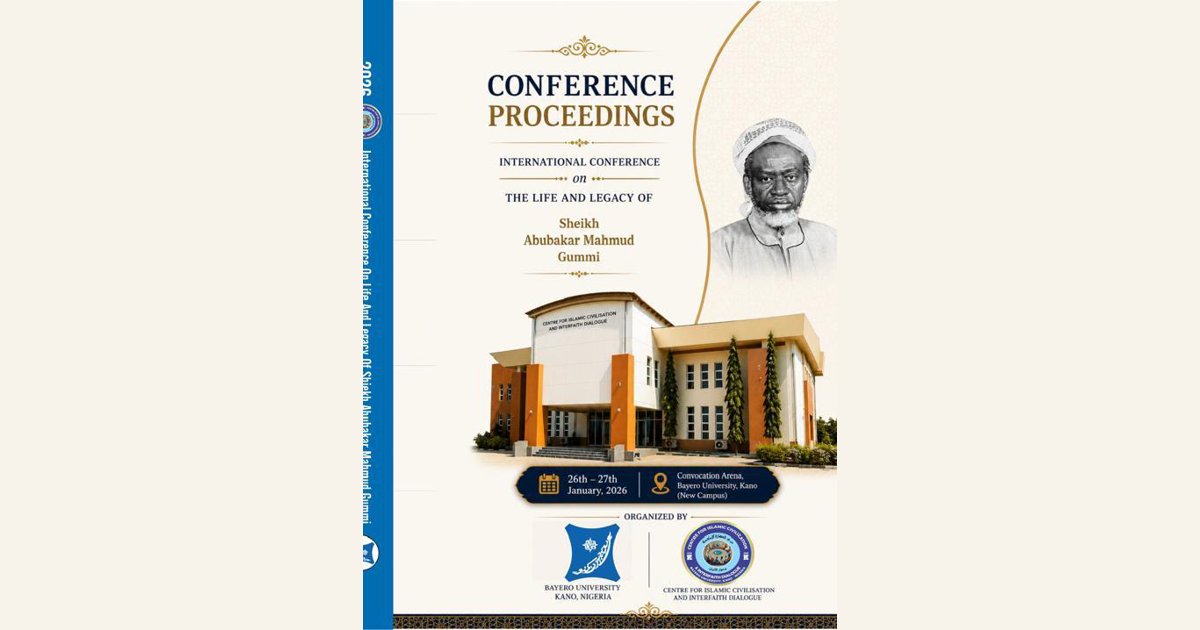
INTRODUCTION. Sheikh Abubakar Mahmud Gummi is a prominent Nigerian Islamic scholar and religious leader whose legacy in interfaith dialogue and sociocultural coexistence in modern Nigeria is profound and significant. Gummi, who lived during the 20th century and into the early 21st century, was particularly known for his commitment to peace, dialogue, and understanding among Nigeria's diverse religious and ethnic communities. Early Life and Background Born in 1924, Sheikh Gummi was deeply rooted in both Islamic scholarship and the traditions of Nigerian Sufism, which he criticized later in his life. He became one of the foremost Islamic scholars in Nigeria, holding a significant position within the Islamic community. His education in both traditional and modern forms of learning gave him a unique perspective on the role of religion in the public and social life of a multi-religious nation like Nigeria.
Gummi's Contributions to Interfaith DialogueOne of the Sheikh Gummi's most important legacies is his active engagement in interfaith dialogue, particularly between Muslims and Christians. Nigeria, with its significant Christian and Muslim populations, has often experienced tension between these groups, especially in the context of political, social, and economic struggles. Gummi recognized the potential for interfaith dialogue as a means to mitigate these tensions and promote peace. 1. Promoting Peaceful Coexistence Sheikh Gummi’s commitment to peaceful coexistence was grounded in the teachings of Islam, which he interpreted as being inherently peaceful and tolerant.He consistently emphasized the importance of mutual respect between Muslims and people of other faiths. He often spoke out against religious intolerance, extremism, and violence, stressing that these acts were contrary to the teachings of Islam. 2. Dialogue with Christian Leaders Gummi was known for initiating and participating in dialogue with prominent Christian leaders in Nigeria. His belief in fostering understanding and cooperation between Muslims and Christians was pivotal in promoting unity in the face of religious tensions. Through these dialogues, Gummi worked to address misconceptions and stereotypes between the two religious communities, encouraging both sides to focus on shared values such as love, compassion, and justice.
3. Interfaith Collaboration on National Issues
During times of political or social unrest, Gummi worked alongside Christian leaders and other religious figures to address national issues such as communal violence, political corruption, and poverty. He was part of various religious councils and organizations that aimed to foster national unity through interfaith cooperation. This collaboration was particularly important in Nigeria’s context of religious and ethnic divisions, as it helped create a platform for leaders to advocate for the peaceful resolution of conflicts. The Area of Sociocultural Coexistence in Modern Nigeria In addition to his work in interfaith dialogue, Sheikh Gummi made significant contributions to promoting sociocultural coexistence in Nigeria. Nigeria's diverse ethnic groups, traditions, and languages have always posed challenges to national unity, and Gummi's efforts were crucial in advocating for harmony within this complex social fabric.
1. Cultural Tolerance and Respect
Gummi's teachings emphasized the importance of understanding and respecting the cultural traditions of others, including the non-Muslim communities. His work in interfaith dialogue was not limited to just religious leaders but extended to the broader Nigerian society, where he advocated for a culture of respect and tolerance. He believed that all Nigerians, regardless of their faith or ethnicity, had the right to live in peace and dignity.
2. Role in Promoting Religious Pluralis
In a country as diverse as Nigeria, religious pluralism can be a source of both tension and opportunity. Sheikh Gummi understood the importance of religious diversity in a democratic society, and he played an active role in promoting religious pluralism. He argued that Nigeria’s strength lay in its diversity and that the different faith communities should not see each other as adversaries, but rather as partners in building a stronger, united country. He emphasized this in his Tafseer: "Raddul Az'haan..." at verse 118 of chapter 11, (Suratu Hud) of the Glorious Qur'aan. 118. “If your Lord had willed, He could have made mankind a single community”; that is, followers of one religion, which is Islam. However, He did not cause everyone to be Muslim because it was not His will to do so. “But they will not cease to differ” in matters of religion, resulting in diverse faiths such as Judaism, Christianity, Magianism, Idolatry, and Islam. Moreover, adherents within each religion have also split into various sects. It was narrated by Abu Huraira, may Allah be pleased with him, that the Prophet (P.B.U.H) said: “The Jews divided into seventy-one sects, or seventy-two sects; and soon my Ummah will be divided into seventythree sects, seventy-two of which will be in the Hellfire, and one in Paradise.” These sects refer to those inclined toward innovations and selfish desires, such as the Khawarij (dissidents), the Qadariyya, the Mu'tazila, and the Rafida. However, “the one sect” signifies the followers of the Sunnah, who form the core of the Islamic Community." 3. Influence on Political and Social Leadership As a spiritual leader, Gummi was highly influential in the political and social spheres of Nigeria. He had close relationships with many Nigerian leaders and used his position to promote the values of interfaith harmony and cultural coexistence at the national level. His approach was one of moderation, calling for a balanced perspective that respected Nigeria's religious and cultural diversity while also upholding national unity.
4. Educational and Social Contributions
Sheikh Gummi also emphasized the importance of education in fostering understanding and coexistence. He advocated for religious and secular education, believing that both were necessary for building an informed and enlightened citizenry. His teachings encouraged Nigerians to embrace knowledge and education as tools for breaking down religious and cultural barriers. Gummi’s Legacy in Modern Nigeria Sheikh Gummi’s influence can still be felt in modern Nigeria, particularly in the way religious and ethnic tensions are managed. While challenges remain, his legacy is reflected in the ongoing efforts by religious leaders, civil society organizations, and political actors to promote peaceful coexistence in the country. His commitment to interfaith dialogue, cultural tolerance, and social harmony has made him a central figure in the quest for national unity in a deeply divided society. His teachings continue to inspire contemporary religious leaders and scholars who view interfaith dialogue not as a mere option but as a necessary and urgent task in a nation as religiously and culturally diverse as Nigeria.
Conclusion in seven (7) special areas:
1. Sheikh Abubakar Mahmud Gummi's legacy in interfaith dialogue and sociocultural coexistence has had a lasting impact on modern Nigeria. His vision for a peaceful, united Nigeria—built on mutual respect, tolerance, and understanding between religious and cultural communities— remains relevant today. As Nigeria continues to navigate its complex social and religious landscape, the values Gummi espoused are crucial in guiding the nation towards greater harmony and unity.
2. In the history of Nigeria; Sheikh Abubakar Mahmud Gummi used to be a towering figure in Nigerian Islamic scholarship and reform/tajdeed... Thus his legacy in interfaith and sociocultural coexistence is profound, marked by his advocacy for unity among Muslims and peaceful coexistence with non-Muslims. As the Grand Khadi of Northern Nigeria, Gummi promoted a balanced approach to Islamic practice, adapting principles to modern realities while staying true to the Quran and Hadith.
3. Gummi's contributions to Islamic education and reform are notable. He co-founded Jama’atu Nasril Islam (JNI) to promote Islam and foster unity among Muslims. His radio programs and writings disseminated Islamic teachings, and he encouraged Western education alongside Islamic studies.
4. Gummi's stance on interfaith relations is significant. He believed Nigerian Muslims should coexist peacefully with non-Muslims, despite advocating for Islamic governance. His efforts earned him international recognition, including the 1987 King Faisal International Prize for Service to Islam.
5. Gummi's impact on Nigerian society extends beyond interfaith relations. He championed women's rights, urging Muslims to allow women to vote and participate in politics. His reformist ideas, though sometimes contentious, have shaped Islamic discourse in Nigeria. 6. Gummi; the Embodiment of simplicity and levelheadedness. In the middle of 1985, I witnessed how he used to captivate the minds by that attitude of humility. I came to him around 3: 00 p.m. and said, "please akramakallaahu I want you to go with me to the Ahmadu Bello University Teaching Hospital of U/Rimi Kaduna, for you to see a diabetic patient brought from my hometown Malumfashi, (Alhaji Sani Ɗanƙwara Mai Fata)".
He said to me, "Muhammad Sani wait till after the Asr prayer". And after the prayer he simply invited his driver (late Alhaji Salisu) and his personal assistant (PA) Alhaji Sani Mani for the visit. And the four of us in his car, went to the hospital, where he greeted the patient and supplicated to Allaah for in his healing. That action became a breaking news in Malumfashi, and taken as a historical event up to now, especially to his immediate family, his associates and his loved ones!
Another Angle of Humility.
The humility of Sheikh Gummi is natural and not fake, because when our driver came to one of the gates of the hospital, which was closer to the amenity wards, where our patient was; the security didn't allow us in. He said that we either go to the other gate or keep our car outside and go afoot via the small gate. In that while the PA to the Sheikh tried to argue or persuade the security to allow us in, then the Sheikh simply came out of the car and started going afoot into the hospital.
Soonest when the Sheikh started walking, coincidentally the group medical director (GMD) of the hospital, whose office was not far from there, caught a glimpse of the Sheikh from far and recognized him, then came in a haste and talked to the security, who subsequently let our car in.
6. And another gesture was when I came to him in 1987, that was on my way to the Sudan to further my Islamic studies. I said to him, "akramakallaah I am to go to the Sudan, and I know that you had been there, and you must have had some friends... Please give me the contact of some of them, so that I can consult them whenever I have a challenge in my studies". He responded by saying, "Muhammad Sani, all my friends are no longer alive, and the only living among them was the one that died just few months ago. However, I assure you that you will find the Sudanese teachers, when they find a hardworking student, they will take him as their son".
And when I came back to Nigeria 2 years later for a holiday, I came and confirmed to him what he told me, that I got it very correct as he said.
SOURCES TO CHECK
1. https://www.sunnahsak.com 2. https://www.abcnews.com.ng 3. https://www.grokipedia.com 4. https://www.desertherald.ng 5. https://www.wikipedia.org 6. https://www.researchgate.net 7. “Reflecting Minds Towards meaning(s) of the Qur`an. By Sheikh Abubakar Mahmoud Gummi”, Translated by Abubakar Buba Luwa & Hassan Abubakar Gummi.
Comments