
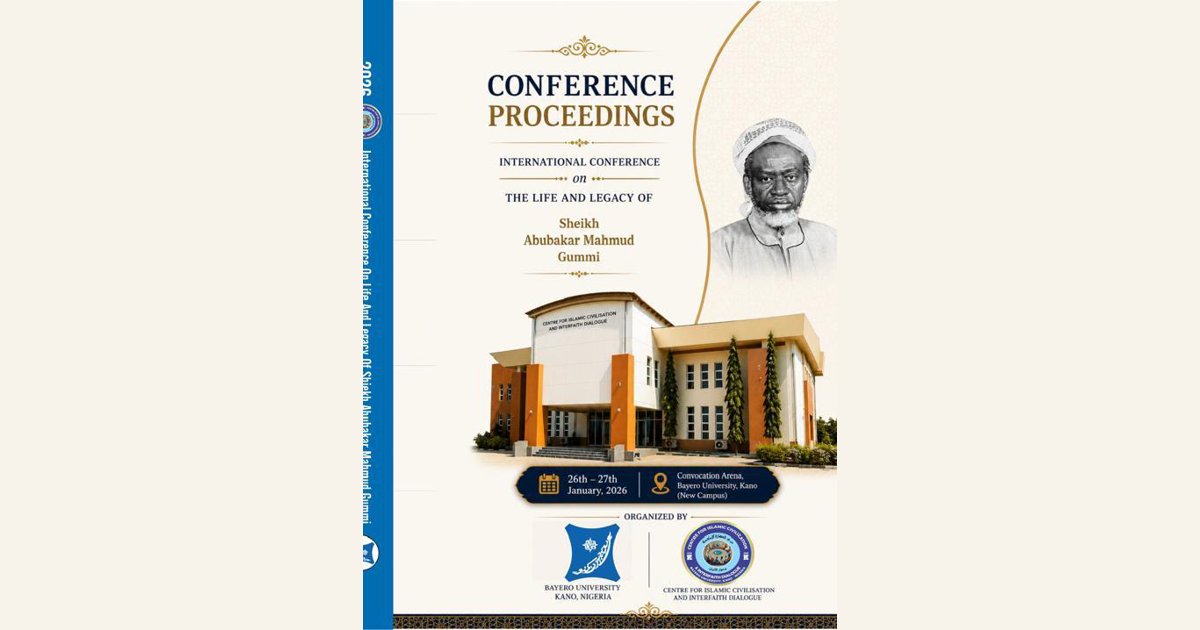
I would like to congratulate the organizers of this conference, the Institute of Islamic Civilization and Interfaith Dialogue, and by extension the entire Management, staff and students of Bayero University for inviting me to be the keynote speaker for this international conference. An academic conference on Sheikh Abubakar Mahmud Gummi is both timely and appropriate as he is one of the most prominent Nigerian Islamic scholars, who has been a major influence in the lives of a large number of people, particularly the elites, and who has significantly impacted on the Muslim Ummah in Nigeria and beyond. I am grateful to Almighty Allah for making me, I think, the only living person who knew Sheikh Abubakar Gummi long enough, either from his own family, students, associates or friends. In writing this keynote paper I have decided to focus only on three key areas hoping that the other papers to be presented would cover all the remaining areas of the theme of the conference. These areas are my relationship with Sheikh Abubakar Gummi, his major ideas and his distinct qualities. My Relationship with Sheikh Abubakar Gummi The first time I met Gummi, as he was then called, was in 1946; that is about 80 years ago, the year I was admitted into the famous institution in Nigeria then called Madrasat ul Shari'ah al Kubra (Advanced School of Shari'ah). I was then barely 12years old but he was probably already 24 years in age, much older than I was. He was then in his fourth and final year of the school. Interestingly enough, he was the captain of the football team of the school and also the chairman of the Debating Society. I happened to be interested in both. The Debating Society used to meet every Wednesday while the footbalI team met daily each afternoon. This was to be the beginning of a strong relationship that kept on growing until his death in 1992.
In 1947, he graduated and, in accordance with the tradition of the school to retain the best student as an assistant teacher, he was engaged. For me, he was transformed from a senior student that I looked up to as a coach in football and debating skills to a teacher. I remember very well that he taught us, in our second year, Arabic grammar and Tafseer the interpretation of the Noble Qur'an. Even as an assistant teacher, he was very effective and liked by all students. He remained there teaching until the early 1950s. This teacher-student relationship was to be retransformed to friendship when six of us (Abubakar Gummi, Haliru Binji, Hassan Gwarzo, Abdulkadir Imam, Ibrahim B. B.faruq and myself) got scholarships to enroll in a diploma course at the Bakhter-Ruda Institute of Education, Ad-Duwaym, Sudan. We were selected after about sixty (60) of us sat for a special examination organized by the School for Arabic Studies. The institute was staffed by highly educated Sudanese and British academic staff. At that time, it was the only institute offering a diploma course in Education for the Sudan.The subjects we studied there included Arabic, Islamic Studies, English, General Studies and Islamic History. Studying the same subjects and living in the same quarters gave me the opportunity to get very close to him and to understand him well. One of the pleasant opportunities we had at that time was to perform Hajj together in 1955. We applied to the school authorities and were granted permission to travel by sea to Jeddah and we then travelled by land to Makkah and Madina. The opportunity of having our first hajj together was a memorable experience for all of us that we often recalled whenever we met. When we eventually returned to Nigeria, we were all employed as superintendents of education and posted to different schools in the Northern Region. I was posted to School for Arabic Studies, Kano, while Gummi was sent to a school in Maru-now part of Zamfara State where he met as co-teachers Mal Abubakar Tafawa Balewa and Malam Aminu Kano. All three of them became actively involved, in one way or the other, in the political activities that were going on before Nigeria gained its independence. In the case of Malam Abubakar Gummi, it was here that he intensified his ideas of Salafiyya (going back to the practice of the companions and those who came after them) and commenced his attacks on Bid'ah (innovations in the form of beliefs and practices that have no basis in the Qur'an and Sunnah). One particular issue, at that time, that brought Malam Gummi in confrontation with Sokoto ulama related to Tayammum. It was rumored that water from ordinary wells in Sokoto, at that period,was not hygienically good and might not even be safe to use. Many people, including some imams of mosques, thus applied Tayammum instead of Wudhu whenever they performed their obligatory prayers. Malam Gummi vehemently condemned that practice and called on the authorities in Sokoto to prevent all these imams from leading obligatory prayers in the mosques. This caused havoc, confusion and hot arguments among the Ulamma in Sokoto, and many criticized Malam Gummi for this confusion. Malam Gummi was to return to the School for Arabic Studies, Kano where I already was, after a few years at Maru and we were again together for a few years. In 1962,however,he was appointed as one of the judges of the newly established Shari'ah Court of Appeal and he left Kano for Kaduna. He worked as a judge under Sheikh Awad,the first Grand Khadi. After two years, he became the Grand Khadi, a position he maintained for several years. His departure to the Shari'ah Court of Appeal in Kaduna physical separated us but we remained in touch. Shortly thereafter,the Premier of the Northern Region, Sir Ahmadu Bello, the Sardauna of Sokoto, set up the first Regional Advisory Committee on Islamic Affairs to advise his government. The main function of the Committee was to discuss religious and socio-religious issues that sporadically occurred - and led to riots and disturbances causing a great deal of destruction of lives and properties -and advise the Government on how to deal with the situation. Both Sheikh Abubakar Gummi and I were members of the Committee as well as some of our SAS colleagues and many other Islamic scholars from different provinces. As I remember, during the first meeting, the Sardauna talked at length about the security situation in the North.The meeting then discussed other issues including Hajj affairs, Zakkah, the citing of the new moon and the organization of Qur'anic schools. Then, as always, Mal Abubakar Gummi was very vocal in presenting his ideas and suggestions. The Committee met three times before the first military coup that toppled the then civilian government. I also frequently met with Sheikh Abubakar Gummi during meetings of the Jama'at Nasrul Islam (JNI), an organization that he was a founding member of. JNI was established under the leadership of Sir Ahmadu Bello, the Sardauna of Sokoto, as a unifying platform for Nigerian Muslims, especially those from the North. On my part,I used to attend as the Principal of the School of Arabic Studies (SAS) and often assisted the secretariat in writing minutes of the meetings and compiling reports. I had the opportunity of working again, closely with Sheikh Gummi when, in 1979,Major General Shehu Yar’adua, the then second in command to the Head of State, Lt.General Olusegun Obasanjo set up a committee to mediate between warring Islamic groups. The Committee had, as memmbers, leaders of the Qadiriyya and Tijjaniya sects as well as Malam Abubakar Gummi and myself, amongst other notable Islamic scholars. It was meant to unify all the various groups and strengthen brotherhood ties amongst all Nigerian Muslims. A communique was written in Sokoto under the chairmanship of Sultan Abubakar III and distributed widely.
More recently, while I was the Nigerian Ambassador to Saudi Arabia, I had the chance to meet several times with Sheikh Abubakar Gummi when he visited the Kingdom. We would have long talks in which we discussed our days in SAS and Sudan, the problems facing Nigerian Muslims and the future of the Ummah. We also had the opportunity of performing hajj again together a number of times but these occasions never came close to our first hajj together. The Major Ideas of Sheikh Abubakar Gummi From the time he started as a teacher, Gummi was very courageous and fearless. He was keen to express his views and ideas in accordance with his religious convictions no matter who it offended. In Maru, for example he openly and strongly criticized the practice of Tayammum (instead of Wudhu) by some of the imams who were then leading the obligatory prayers in mosques. The Sokoto Emirate,at that time, and many people disagreed with him and opposed his views but that did not discourage him or prevent him from disseminating his own understanding and ideas. As a teacher in SAS Kano, his ideas quickly spread among students and some elites in Kano. There and then, he began to challenge those that followed innovative practices of both the Tijjaniyyah and Qadiriyyah. He was strongly opposed by both but that did not stop him. Sheikh Abubakar Gummi authored several books in Hausa and Arabic including the translation and interpretation of the Noble Quran which was printed and distributed by the Saudi Arabian Government. One other important bookhe wrote in Arabic was "Al-Aqeedat ul-Sahihah bi Muwafaqat al-Shari'ah (The Authentic Faith in Following the Shari'ah)." In this book, he fully explains the meaning of the "Kalimat al-Shahadah" stressing that no one has any right to bring new Islamic methods of Ibadah (worship) after the death of the Noble Messenger of Allah, Muhammad (SAW).According to him, this contradicts the verse of the Glorious Qur'an that states: “Muhammad is not the father of any of your men but (he is) the Messenger of Allah and the seal of the Prophets and Allah has full knowledge of all things" (Al-Ahzab 40) By and large, Sheikh Abubakar Gummi's ideas revolve around the concept of following the practice of Salafiyya (ie what the salafus Salih of the companions of the Prophet Muhammad (SAW) and their followers used to do). Along with this,he also preached and condemned initiating any new method of worshipping in Islam which he called Bid’ah Muharramah. In all these he used to cite verses of the Noble Qur'an and Hadiths of our Noble Prophet Muhammad (SAW). Personal Qualities of Sheikh Abubakar Mahmoud Gummi
My close and very long relationship with Sheikh Abubakar Mahmoud Gummi allowed me to interact with him from near, to study him very closely and to understand him fairly well. Let me at this juncture go into his personal qualities which gave moral weight and credibility to his ideas, teachings, and reformist efforts. First,he was a very simple person. This is quite strikingin view of the fact that he commanded immense respect as a scholar and as the Grand Khadi of the Shari'ah Court of Appeal. This simplicity is something that he had right from the time I first met him. He lived a modest life and he avoided ostentation in dress, speech, and lifestyle.He exemplified the fact that scholarship and religious leadership should be grounded in humility and service rather than social privilege or material display.This simplicity made him approachable to people from all walks of life. Whenever you went to his house, it was always full of people wanting to see him for one reason or another and his doors were always open. For me, I had the distinct privilege of seeing him anytime I wished to and sometimes he would take me even to his inner rooms. Sheikh Gummi was also very jovial and had a warm nature. He was widely known for his sense of humor, friendliness, and ease of interaction and he related comfortably with everybody; students, colleagues,traditional rulers, politicians, civil servants, businessmen and ordinary members of the public. His laughter, light-hearted remarks, and relaxed disposition always created an atmosphere conducive to learning and dialogue. I remember this jovial nature from my very first days at SAS during my first encounters with him. Sheikh Gummi's passion for knowledge was deep, sustained, and lifelong. He approached learning as an act of worship and teaching as a sacred trust. HHe read widely, reflected deeply, and constantly sought clarity and evidence in religious matters. This passion was reflected in his prolific teaching, writing, and public lectures, as well as in his commitment to intellectual rigor and textual authenticity. I remember that, while we were at the Bakhter-Ruda Institute of Education, Sudan, we had a rigorous academic schedule as well as some extra-curricula activities. In addition to all these, Gummi was personally engaged in the memorization of the Noble Quran. Sheikh Gummi was also renowned for his excellent teaching style. He possessed a rare ability to simplify complex religious concepts without trivializing them. His lessons were clear, structured, and evidence-based, often drawing directly from the Qur’an, Hadith, and classical scholarly works. He encouraged critical thinking, asked probing questions, and challenged students to engage directly with primary sources.His mastery of his subject matter and very jovial style of teaching enabled him to captivate diverse auidiences, making his teachings accessible to both scholars and laypersons. Many of his students later became prominent scholars, preachers, and public servants, a testament to the enduring impact of his pedagogy.
One of his most admirable qualities was his reputation for incorruptibility. At a time when public trust in religiouus and political figures was often strained, Sheikh Gummi stood out for his honesty, financial integrity, and moral discipline. He was known to reject personal enrichment through public office or religious authority, and he consistently spoke against corruption, injustice, and abuse of power. His personal conduct reflected his teachings, reinforcing the credibility of his message and setting a powerful example for future generations of scholars and leaders. Equally notable was his uncompromising nature on matters of principle. Sheikh Gummi was firm and resolute in defending what he believed to be the authentic teachings of Islam, even when such positions were unpopular or provoked strong opposition. He was not swayed by public opinion, political pressure,or personal convenience when it came to religious truth as he understood it. This firmness earned him both admiration and criticism.His students and supporters praised him for this uncompromising nature but many people felt that he was too hard and undiplomatic on followers of the Tijjaniyyah and Qadiriyyah sects and they accused him for bringing a lot of division within Muslims in Nigeria. Some others were of the opinion that he had failed to control his supporters and faithful adherents who often took very extreme positions on the leaders and followers of the dariqah sects. In summary, the personal qualities of Sheikh Abubakar Mahmud Gummi-his simplicity, warmth, passion for knowledge, excellent teaching mmethods and moral integritywere integral to his success as a scholar and reformer. These traits not only defined his character but also amplified his influence, ensuring that his legacy endures not merely through his writings and institutions, but through the lives and values he shaped. Conclusion There is no doubt that Sheikh Abubakar Gummi was one of the most prominent Nigerian Islamic scholars, who, through his teachings and interpretation of the meaning of the Glorious Qur'an in Sultan Bello mosque in Kaduna, became a major influence in the lives of a large number of people, particularly the elites. Within Nigeria and outside, he is regarded as a reformer who has contributed significantly to the spread of Islamic knowledge in the country and to re-awakening the true practice of Islam amongst all strata of society. In his status as the Grand Khadi of the Shari’ah Court of Appeal, a position he held for many years after he replaced Sheikh Awad, he brought significant reforms in the way the Shari'ah Court of Appeal and other Shari'ah courts operated all over the country. As one of the founding members of Jama'at Nasrul Islam, a platform used at that time by the North Regional Government to unite, educate, and promote the interests of Muslims in Nigeria, he strove to make it a vibrant organization in all parts of the North. Together with some of his ardent followers, he eventually established around 1978 the Jama’at Izalat al-bidah wa Iqamat as-Sunnah, an organization aimed at purifying Islamic beliefs and practices as well as promoting education and social welfare. It has become one of the major Islamic organizations in the country greatly influencing religious thought and practice all over the nation. Through out his life, Sheikh Abubakar Gummi promoted,in his teachings, the idea of Salafiyyah - that is practicing Islam in accordance with the views and practice of the Companions of the Noble Prophet, Muhammad (SAW)and their descendants, the Tabi'un. In 1987, he received the prestigious King Faisal International Prize for his service to Islam. Throughout his life, Sheikh Abubakar Gummi was firm and resolute in defending what he believed to be the authentic teachings of Islam. This firmnness earned him admiration from his followers but criticism from those that he was too hard on. Other people felt that he was sometimes influenced by his followers to take rather extreme positions on the leaders and followers of the dariqah sects. May the Almighty Allah reward him abundantly for his service to Islam and May He continue to shower His blessings and forgiveness to him. Prof. Shehu Ahmad Sa'id Galadanci 21st January 2026 / 7th Sha'aban 1447AH
Comments