
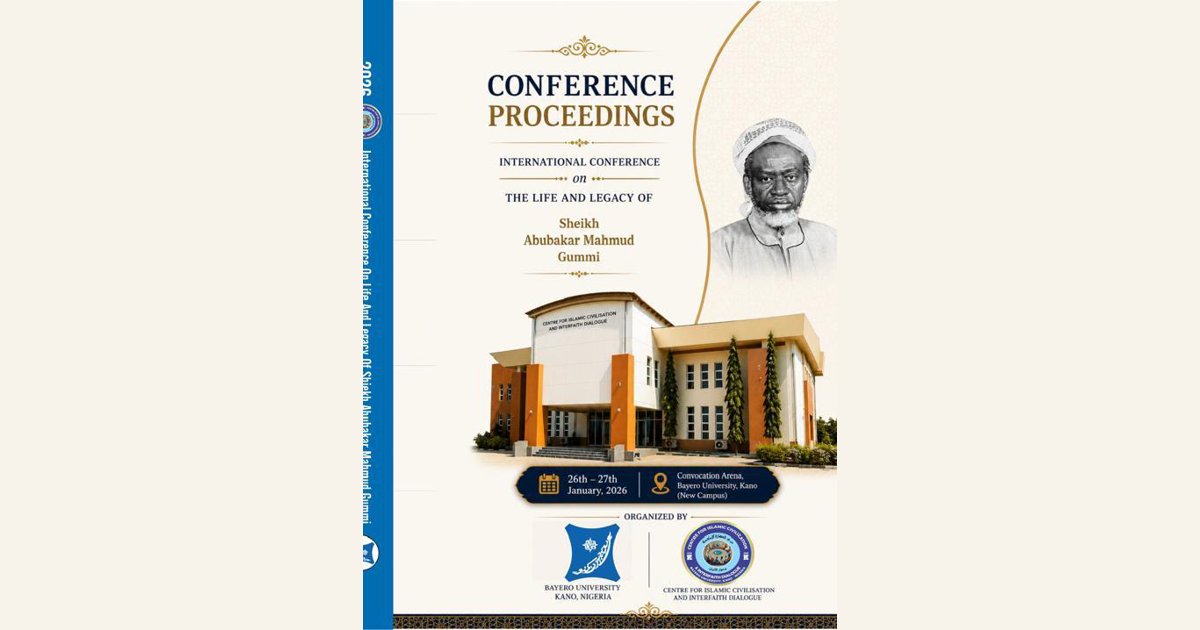
of the country, and reading circles began to spread through the Hausa land with sunni ideologies where most of the people especially the deciples and Muslim learners began to be influenced with voice of Sheikh Abubakar Mahmud Gumi. The paper will intend to looks into influence of the tafsir written by the sheikh “Radd al-azhanilaMa’an al-Qur’an” in hausa land. In doing so, a brief biography of the sheikh will be discussed. Brief Biography of Sheikh Abubakar Mahmud Gumi Early life and education Gumi was born in the village of Gummi now a local government area in Zamfara state on the last Friday of Ramadan in the Islamic year 1344, (1922) to the family of Mahmud, an Islamic scholar and Alkali (judge) of Gummi. His education started within the walls of his family when he was a pupil of his father’s Islamic teachings. He later sent to a school under the tutelage of a Malam called Musa at Ambursa, Sokoto province. There he was introduced to Fiqh and read books and praise poems on the prophet. The first modern school he attended was the Dogondaji Primary School, while in primary school, he met the future 18th Sultan of Sokoto, Ibrahim Dasuki and excelled in religious duties.568 He was given a tittle ofHakiminSalla (leader of prayer) and was delegated responsibility for catering to the student’s religious activities. Within a year, he was transferred to the Sokoto Middle School, where Ahamdu Bello was teaching, there he was acquainted with Shehu Shagari, Waziri Muhammadu Junaidu, and Yahaya Gusau, the latter was a co-founder of Jama’atnasr al-Islam, a prominent Nigerian Muslim organization.After completing his studies at the middle school, he went to Kano to study Law and was trained as a Qadi. He started work as a scribe to Qadi Attahiru but he soon became disenchanted with the specifics of his job. He gave private lessons on Islam and tafsir as an escape from his disenchantment. He lost his father in 1937 while he was at the middle school. He got married 3 years later to Maryam in 1941569 His career Abubakar Mahmud Gumi, was an outspoken Islamic scholar and Grand Khadi of the Northern Region of Nigeria (1962–1967), a position which made him a central authority in the interpretation of the Sharia legal system in the region. He was a close associate of Ahmadu Bello, the late premier of the Northern region in the 1950s and 1960s and became the first Grand Khadi in 1967, the position was abolished. Sheikh Gumi emerged as a vocal leader during the colonial era, where he felt the practice of indirect rule had weakened the religious power of Emirs and encouraged westernization. Beginning in the 1960s, public conflicts emerged between him and leaders of the Sufi brotherhood, some of whom he later debated on television programs in the 1970s and 1980s.By that time, he had managed to keep his ideas in the spotlight by holding Friday talking sessions inside the Kaduna Central Mosque (Sultan Bello Mosque). He used the sessions to revive his criticism of established authorities based on his views of a back to source approach or the need to embrace a puritanical practice of Islam. He also criticized
568 Sheikh Abubakar Mahmud Gumi, Where I Stand, Translated by Prof. Isma’il Tsiga. P. 47-50 569 Where I Stand, Gumi P. 79-90 harshly the involvement of mysticism and the resulting syncretized practice of the Sufis.He had a large number of children. However, his most popular child happens to be Dr Ahmad Abubakar Gumi who succeeded his father as the scholar of his mosque at Kaduna (Sultan Bello Mosque), Dr Ahmad Gumi is a certified medical doctor from Ahmadu Bello University Zaria and was a former military officer, he left the military and traveled to study fiqh (Islamic jurisprudence) at the umm Al-Qura University in Mecca, Saudi Arabia where he obtained his PhD.570 Purpose of writing and naming the Tafsir The books of the translation of the Qur’an that I have numerously read have been earlier lengthy or too short. May Allah have mercy on the scholars who have writing them. However, I have seen that despite the multiplicity of those books, we today need a brief iterpretation of the Qur’an, which would explain the meaning of the Qur’an in a way that they could be understood and applied to work. Indeed, most of the stories that have been introduce into interpretation of the Qur’an have made minds weary. That has made people read the stories for amusement and not in order to work with the lessons, admonishes and laws that the Qur’an contains, some times that could lead to the ascription of what is not legally or rationally right to prophet, angels and the righteous who are the best among the servant of Allah. This could happen, despite the fact that all Qur’anic stories be present lessons, and when they are repeated. It will be because of some purpose determined by the place (i.e, context and those stories are lengthor short in order to explain the purpose that the chapter addresses this is because every chapter is placed for some principal topic even if some topic that are correspondingly mentioned come in. I shall explain all that in (the proper) place by the grace of Allah, depending on the narration of Hafis bin Suleiman bin al-Mughira al Asady, from the citation of Asim bin Abi an-Najood, due to its popularity and because I have been able to ascribe the source of the prophet, (PBUH), by means of my erudite scholar Sheikh Sa’ady Yaseen. His source is, in deed, famous. I may some time refer to some other narrations of recitation if the place need that, as well as to the prominent mode of the Maliki school of law. I may also refer to schools other than Maliki school and to the Arabic knowledge and stories that are un avoidable. I have named the book. “Reflecting minds towards meaning of the Qur’an”571 The Method and Strategy of Tafsīr Rad al-Azhan The Tafsīr Rad al-Azhan is usually categorized as a Tafsīrbil-Ma'thūr — that is, a ‘commentary based upon transmitted knowledge’ (from the Ḥadīth, the first Tafsīrs and the early Islamic history books, usually) — this being the primary category of perhaps six or seven traditional categories of Tafsīr.In fact, in addition to the material handed down from the time of Prophet Muhammad (p.b.u.h.), the Tafsīr al-Rad al-Azhanuses a number of different approaches to explaining the Qur’anic text, not all of which can be attributed only to transmitted Tradition or tafsīrbil-ma'thūr. These include precisely ‘linguistic commentary’, ‘legal or Shari‘ah commentary’
570Aminu I the Role. Jama’atu Izalatul Bid’ah Wa Iqamatis-sunnah (JIBWIS) in the conduct of Islamic Da’awah in West Africa Gaskiya Printing Press
571 Authors notes, in the Reflecting minds towards meaning of the Qur’an. Roman x and tafsīrbil-tafsīr as mentioned below (as different categories of commentaries). He also includes, a few other elements, perhaps no less important. Thus, in addition to following: (1) giving transmitted explanations and quoting ḥadīth about Qur’anic verses, (2) providing Arabic synonyms for difficult Qur’anic words, (3) elaborating on legal explanations of verses according (mostly) to the Shafi‘i school of jurisprudence, and (4) putting into context, perspective and mutual definition verses from the Qur’an using other verses about related matters (i.e. practicing tafsīrbiltafsīr), the Tafsīr al-Rad al-Azhanuses the following Commentary strategies: (5) It gives the Asbāb al-Nuzūl (the ‘occasions for Revelation’, that is, what was happening to and around the Prophet (p.b.u.h.) when a verse or verses were Revealed (ostensibly in answer to these circumstances) for selected verses when they are known (this of course is a purely Ma'thūr element of Commentary). (6) It indicates which verses are abrogated (mansūkh) and the verses that abrogate (nāsikh), (this should be a purely ma'thūr element, but is arguably not always so). (7) It notes the seven (or ten) different ‘readings’ (qirā’āt) of the Qur’an and briefly discusses their divergent emphases. (8) It discusses the grammar of the Qur’an according to that of the Arabic language, and explains the grammatical forms occasionally to be found in the Qur’an. (9) It clarifies many Arabic and Qur’anic linguistic tropes by filling in deliberate omissions and ellipses strategically employed in the Qur’an, and by suggesting meanings for synecdoche, metonymy, metaphor and allusion used in Arabic. (10) Finally, it goes against, Commentaries gleaned mostly from early Christian and Jewish converts to Islam (and therefore containing some confused, polemical and apocryphal material), the historical order, details and context of many of the stories in the Qur’an concerning the Biblical Prophets and Jesus (p.b.u.h.) and his family and disciples. This element is known in Arabic as Isrā’īliyyāt (‘Tales of the Children of Israel’)572 Conclusion Tafsir Al-Rad al-Azhan is one of the most significant tafsirs, or commentaries, for the study of the Quran in hausa land. Composed by Sheikh Abubakar Gumi, Tafsir Al-Rad al-Azhan is generally regarded as one of the most easily accessible works of Quranic exegesis because of its simple style and two to three volume length. For the first time ever Tafsir Al-Rad al-Azhan is completely translated into an unabridged, highly accurate and readable annotated English translation.This Qur’anic commentary is among the popular Tafasir in the hausa land, being going hand in hand with tafsir al-Jalalain perhaps even more popular Tafsir. Its Copies of it are available in almost every bookshop and library in the hausa land, Africa and Muslim world. It is by far the shortest and easiest to understand. Consequently, it is invariably read as an introduction to Classical Tafsirs by millions of students and adults who never go further into the subject. It is thus an immensely successful and influential work not just as the classic introduction to Tafsir, but also as the standard reference work for the language of Qur’an.
572 Ibn Ashur, Attahrir wa Attanwir
The author deliberately summarized, streamlined or simplified the material in order to stay focused on his one overriding aim: to make the literal meaning of the glorious Qur’an completely intelligible in the simplest possible way particularly to the people of sudan and entire Muslim world References Aminu I the Role. Jama’atuIzalatulBid’ahWaIqamatis-sunnah (JIBWIS) in the conduct of Islamic Da’awah in West Africa Gaskiya Printing Press JIBWIS National Headquarters Jos, Aims and Objectives of the Jama’atuIzalatilBid’ahWa’iqamatis-Sunnah (Constitution) Gaskiya Co-operation Ltd. Zaria 1981 Loimeier R. Islamic Reform and Political Change in Northern Nigeria, Northwestern University 1997 Hiskett. M. (1984). The Development of Islam in West Africa, London & New York. Longman Glasse C. (1988) The Concise Encyclopedia of Islam, Harper Collins Publishers, Columbia University. Where I Stand, Sheikh Abubakar Mahmud Gumi, Translated by Prof. Isma,ilTsiga

Comments